
This is the website repository of some cool stuff I did on the radio and on the television.
It is my intention to offer all of this absolutely for free, so that anyone
who'd enjoy it can either download it or stream it for free.
However,
having said that, if you do get some benefit from my efforts, and can afford to
show your appreciation in a monetary way, it would be most appreciated.
NOTE:
This site is entirely a labor of love.
I
realize that it's painfully obvious that the person who put it together is
nowhere near as skilled at website/app design as he was at producing radio
programs.
This is especially true for those of you who access it on mobile
devices.
Which is sort of a shame, since it's really easy to stream these
shows via Bluetooth from your phone to the car.
(After all, "radio programs"
is what podcasts used to be called.)
So... if you appreciate this material
and have those very skills (website/app design) that I so obviously lack and so
sorely need,
and would like to take on the task of helping me redesign this
thing,
PLEASE
reach out to me.
I don't make a nickel on this (yeah, I know there's a "donate" button, but
it's only been used 2 or 3 times in the roughly ten years this site has been
up),
so I can't afford to spend a lot of money on this,
but I also believe in paying people for their work. We'll talk.
And
now, on with the shows!
|
133 high-larious half hours! (With a few one-hour shows thrown in with no surcharge!) SPECIAL
CHRISTMAS
BONUS: If you like what you hear, you can buy me a drink or a meal or even a vintage Rickenbacker electric 12-string guitar by using the Completely Optional PayPal Tip Jar:
Thanks to ML-J and FB for leading the charge. Now, although the honor of being among the first two donors is no longer available, you can always shoot for being the largest donor. PayPal also conveniently makes it possible for you to set up recurring monthly donations! All expressions of support are warmly appreciated, and come as a very pleasant surprise. I know you're out there. Many thousands of you. If you don't want to, or can't support this site with the donation button, you can use this site to buy some of the items discussed in the programs via the Amazon links thoughtfully provided. (If you don't see these links, it is probably because you have AdBlocker enabled for this site. Go ahead, disable it for this site. It won't kill you.) But since most of the stuff you get through Amazon isn't listed here, if you get into the habit of accessing Amazon through this site, by pressing this button:

this will help defray the costs of the site. My percentage is small, but maybe you could use a new watch?
Thank you. |
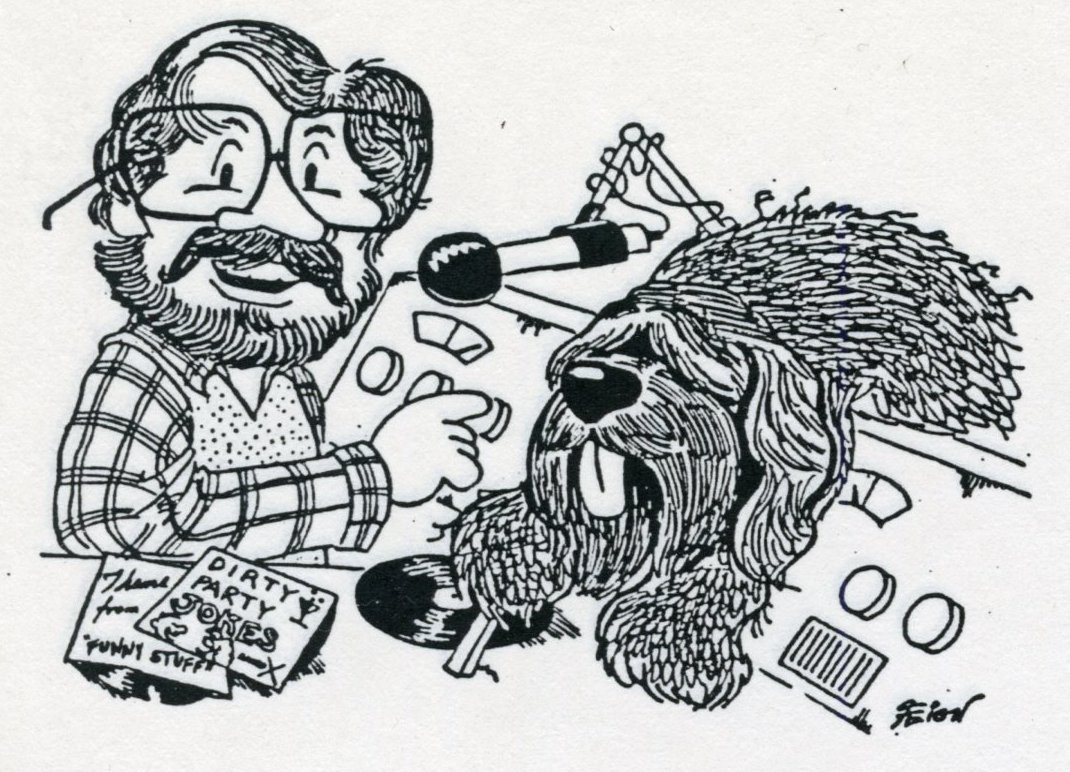
Bob & Daisy on the air! For most of the 1980s, I produced and hosted a radio program on KCRW called "Bob Claster's Funny Stuff." It was a Friday evening half-hour through most of its existence, but for a while was a full hour on Sunday nights. Most of the time I'd play recorded comedy, usually from albums. Often I'd feature a single artist or team, but some of the best shows, I feel, are the ones in which a wide variety of sources are united by a single topic. Occasionally I would also do interviews, when someone I admired was available. It was a wonderful luxury to be able to dispense with the introductory stuff they get asked all the time and go right to the grad-level essay questions.
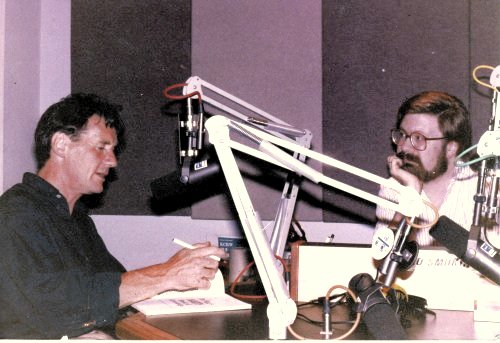
Michael Palin and me, KCRW studios, 1988 The best luxury of all, of course, was the freedom I was given at KCRW. I produced and edited the shows alone in a small studio, and when I was finished, I put the reel of tape in a box on a shelf in a closet. Just before airtime, the engineer would take the tape out of the box and put it on the air. It was that simple. No notes, no critiques, no alterations asked for. That sort of trust is so rare, and was precious to me. I never took it for granted, and tried hard to deserve it.
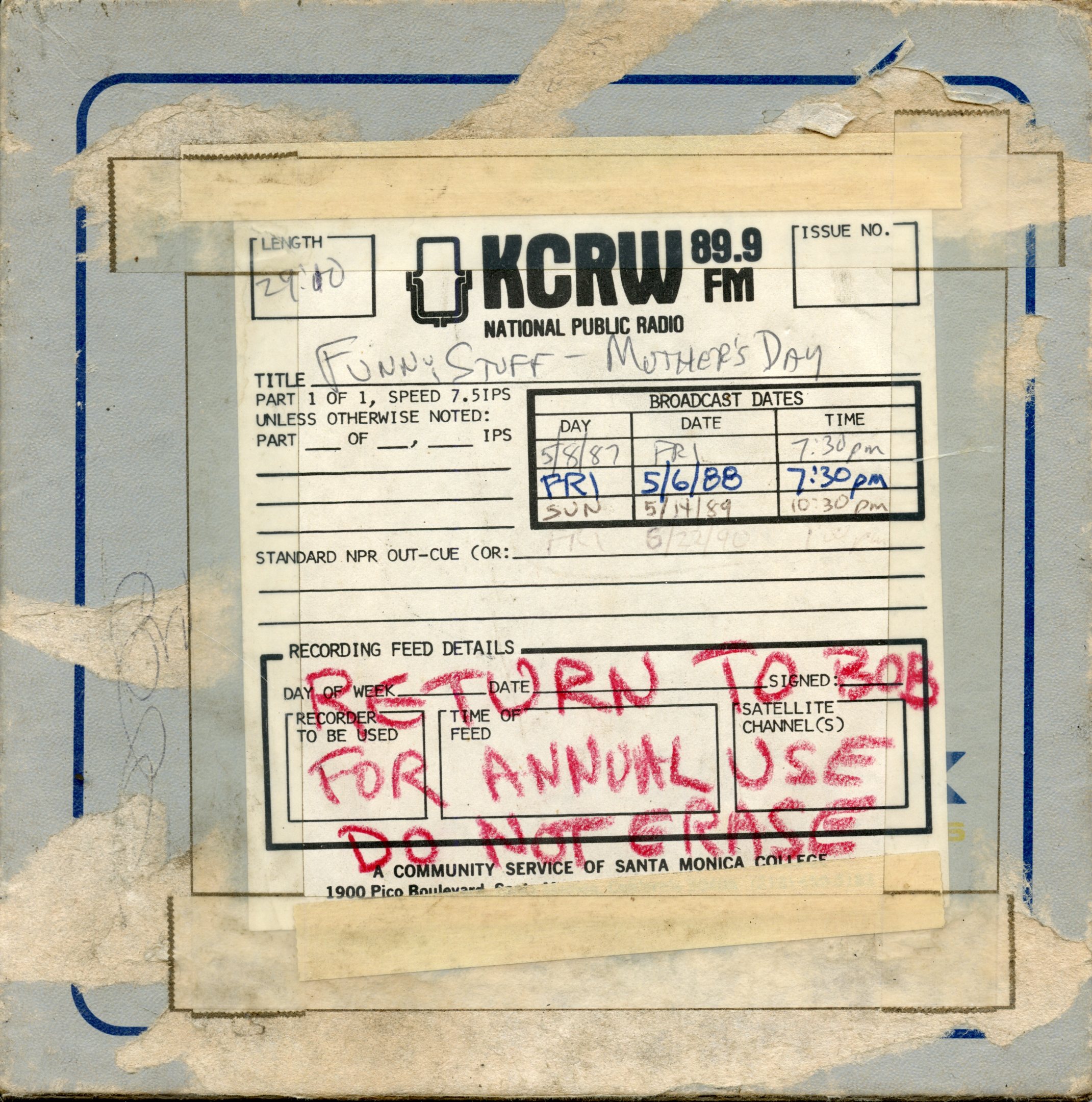
A fairly typical KCRW "Funny Stuff" tape box. Ampex 406, which did not age at all well. Virtually all the KCRW shows produced during the late '70s and '80s were made on this tape, and if you try and play these reels, the tape disintegrates before your eyes, depositing nasty sticky gunk all over the innards of your machine. In order to copy them, these tapes have to be baked at a very specific low temperature in a fruit dehydrator. What fun! Because I put the show together alone in that small room, and rarely listened to it when it was being broadcast, it always surprised me when I'd meet listeners who'd mention something they'd heard in it. I always felt like saying, "Where were you, hiding under the desk?" Here are MP3 files of some of my KCRW radio shows. To stream any of these shows, just click on the link below each descriptions. If you want to download them, you should right-click on the link. If you're overwhelmed by the bounty of what's offered here, and are looking for a good place to start, I think the best of the interview shows is probably the Cleese + Palin one. As for the music shows, the El Queso Grande March '87 one is a lot of fun. And don't overlook The Wibberley Stories. But your mileage may vary. I wouldn't have put anything up here if I didn't think it was worth your time. I hope you enjoy this stuff. Better than it gathering dust around here. Note: writing to me at the KCRW mailing address I gave at the end of each show is highly likely to be a waste of time. I don't work there anymore, the station isn't at that address anymore, and I think there's only one person working at the station now who'd even still remember me. You can contact me by clicking on my name at the bottom of this page. Or here. It's weird... the stats show that each of these shows has been downloaded by thousands of people, and yet I've heard from very few of you. If you like what you hear, drop me a line and say hi, okay? And if you REALLY like what you hear, swivel your head slightly to the left and take advantage of the Completely Optional PayPal Tip Jar in that other frame, or buy something from Amazon through this link. They sell many items of high quality. A NOTE ABOUT LINKING: It's perfectly all right with me if you link to this home page (www.bobclaster.com), but please don't link directly to the files themselves. If you do that, then people don't get to see the whole list, where they might possibly find something else of interest. Or the Completely Optional PayPal Tip Jar, or the Amazon links. In the absurdly unlikely event that you are a listener who happened to record something I did on the radio that doesn't appear here (especially if you have any of the one-hour Funny Stuff shows), and you still have the tape, please contact me!
A NOTE ABOUT THE AMAZON LINKS: The products I've
linked to in the listings were personally chosen by me, and I vouch for each and
every one. In some cases, essential pieces of the puzzle are, sadly, out
of print, but for the most part, the stuff I've listed is the stuff you need.
If you have questions about
the books or DVDs or whatever,
ask me
and I'll tell you. This stuff is important to me, and I love talking about
it. And I'll be so thrilled to find that someone has actually visited this
site. And while you're here... BUY SOMETHING! Your price will not be affected,
but it will just mean that Jeff Bezos will make a little less money, and I'll
get the difference. And, you'll have something shiny and new and wonderful.
How can you survive without the complete set of all 45
Python TV episodes newly (and beautifully) restored for Blu-ray?
|

Before we get to the interviews, I have a challenge for you, just for fun. At one point, in the mid-'90s, I tried to get a book published of these interviews. In order to do so, I had to get permission from the interviewees, as well as the station. All the powers that be at the station gave me their enthusiastic blessing (thanks, Ruth!), and most of the interviewees did too. Most also had very nice things to say about their interviews. However, one interviewee said no, and another asked for a piece of the profit. Can you guess who those two were? I won't post the answer publicly, but if you email your guess to me, I'll tell you if you're right.
DOUGLAS ADAMS
Part One
(55:48)
Part Two
(35:52)
Douglas Adams was the brilliant author of "The
Hitchhiker's Guide to the Galaxy" which, in its original incarnation as a BBC
radio series, was phenomenally successful for the station. At the
conclusion of the umpteenth run of the series, we were able to get Adams to come
down to the station for a chat. This was a golden opportunity to conduct a
grad-level interview, without having to explain who he was and what he was
about. We were able to ask all the picky little nerdy questions of
interest only to the true fans, for whom the show was still fresh in their
minds. The station's Production Director, Tom Strother, conducted this
interview with me. Years later, when
"Dirk Gently's Holistic Detective Agency" was published, Adams came back for
another visit. Since he wasn't a comedian per se, these shows aired on
the station during the day, rather than as part of the "Funny Stuff" series.
When, at one point, I tried to get a book of transcripts of these interviews
published, Adams was particularly supportive and generous. He was a lovely
and very funny man, and his sudden early death in 2001 at age 49 came as quite a blow, especially
to those of us who were lucky enough to meet him. I don't have an airdate
for the first one, but it had to be in the early '80s, as I clearly remember
that it took place in the station's old studios on the campus of John Adams
Junior High School. The original airdate for
the second show was June 29, 1987.
DANNY ARNOLD
(30:06)
Danny Arnold is not a
household name. However, another name, “Barney Miller,” is. And there’d be no
“Barney Miller” without Danny Arnold. Television is a very collaborative
medium, and while there were many people who contributed to the success, both
artistic and commercial, of “Barney Miller,” the show (like “Fawlty Towers” and
only a handful of others) owes its flavor, its consistent excellence, and its
very existence to the stubborn vision of one man: Danny Arnold. Danny Arnold
wasn’t shy about speaking his mind, and there was a lot in it about the state of
television in the late '80s and how it got that way. I'm not sure when
this show aired, but the interview took place on 1/26/87.
I originally contacted Danny Arnold in order to try and locate copies of the six episodes of his short-lived
series, “Joe Bash,” to pass along to John Cleese. However, upon speaking with
him, I had a hunch that he had much to say that would interest my listeners, and
I was right. Danny looked like an old boxer, stocky with very pink skin and
very red hair, and was one of those men who seems incomplete without a cigar.
He was one of the last of a dying breed. Danny Arnold passed away in the summer of 1995.
JOHN CLEESE
But my bitterness didn’t
last long, and when Universal begged me to interview him to promote his film
“Clockwise,” I
relented. I guess I’m easy. I brought portable equipment to L’Hermitage, a
lovely posh yet intimate hotel in Beverly Hills, to record the interview. John
was (and is) a total joy. This was the end of his publicity tour, and it was
obvious that he had answered the same six questions a hundred times. When I
started in about the Footlights Club and Cambridge and “At Last the 1948 Show,” he was clearly
delighted. He gave me much more time than we’d originally scheduled, and
although the Universal press person seemed anxious throughout, wondering if we’d
ever get around to mentioning the film it was her job to promote, he seemed as
happy to discuss this stuff as I was. Making John Cleese. laugh was, and is, one
of the great pleasures of my life, and doesn’t begin to repay for the many
laughs he’s given me. Then again, who ever said that life was fair? Of all the
interviews I ever did, this one required the least editing.
The only notes that may
require a bit of clarification at the outset are these. The movie Terry
Jones was directing was “Personal Services,” the Harvey Korman / Betty White version of
“Fawlty Towers” aired as an unsold pilot and was called “Snavely,"
the “Prue” he refers to is actress Prunella Scales, who played his wife in
“Fawlty Towers,” and the reference to Terry Gilliam and Universal refers to the
well-publicized battle he had with them over his film, “Brazil."
The film with Charlie
Crichton, Kevin
Kline, et. al. did get made and should be well known to most of you under the
name of "A Fish Called Wanda," and is discussed at length in the episode with
Michael Palin. “Clockwise” did only moderate business here in the States, but is a lovely
little film, well worth seeing.
JOHN CLEESE AND MICHAEL PALIN
(30:22)
At the conclusion of the Cleese & Palin session, I asked John for a favor.
I asked him if he would read for my audience a lovely little monologue that he'd
written at Cambridge in 1962. It was later used on the original British
edition of "That Was The Week That Was," but on the LP of material from that show, it's performed by Frost rather than
Cleese. (To hear Frost perform it, scroll down and find the "Funny Stuff"
episode about TW3.) He most
graciously agreed, and to the best of my knowledge, this is the only recording
of Cleese himself performing this material. Enjoy!
John Cleese: REGELLA (aka Startistics)
(2:26)
Part One (29:12)
Part Two
(29:52)
Partly because I was
curious, and partly just because I like getting mail, I once asked the listeners
to write to me and tell me who they thought was the funniest human alive. The
winner, hands down, was John Cleese. I took that as a sign that my listeners
had very, very good taste, or that I had trained them well. So it was only
natural that I’d want to interview Cleese, if at all possible. I spotted a
listing in TV Guide to the effect that he was scheduled to appear on a show that
I knew was taped here in Los Angeles, promoting his first book about psychology
(Families, and How To Survive Them, written with his psychiatrist, Robin
Skinner), and so called the publisher to see if I could be squeezed into his
schedule. Arrangements were made, but at the last minute, he was able to get a
coveted spot on a local afternoon TV show, something along the lines of “Good
Afternoon, Hello, How Are You, Los Angeles.” The TV show was aired live, and so
since TV always seems to take precedence over radio, my interview was canceled.
Heartsick, I watched the broadcast from the station only to see one of the great
figures in the history of comedy interrupted every few sentences by a live
remote interview with Michael Jackson’s gardener on the late-breaking news of
The Gloved One’s whereabouts. Serves you right, I thought.
I think John must
have been pleased by our first interview, as it led to a correspondence that
continued for many years. It started with my sending him a copy of the show as
broadcast, and then I managed to locate tapes of “Joe Bash” for him, which led
to my being able to interview Danny Arnold, but that’s another story. Anyway,
when “A Fish Called Wanda” was released, John and Michael Palin did most if not
all of the publicity together, and since two was the limit to the number of
voices I could reliably record using the remote equipment, they came down to the
KCRW studios to record this interview. Luckily, I had the foresight to record
this one in wide stereo, with each of them in one channel and me in the middle,
since many of the funniest moments were spoken softly by one while the other was
trying to make a point. Again it was in the middle of a grueling publicity tour, and again I
think they enjoyed the ability to go into other topics, reminisce about the Python
days, and just be silly on the radio. What was obvious to all in the studio when this took place, and to all
who heard the broadcast is the obvious love and respect shared by these two
guys. This was certainly the easiest interview I ever did, as you’ll be able to
tell by how few actual questions I had to ask. Original airdate: August 5,
1988.
BILLY CONNOLLY
(56:44)
Connolly seemed almost perversely unwilling to appeal to an American audience. The performance I saw the evening after this interview took place lasted at least three hours, and was utterly brilliant, though it seemed to be specifically tailored to an expatriate crowd. Billy couldn't have been nicer or more generous to me, as we talked in a motel room for about an hour. Although this moment was edited out of the program, we had a nice little chat about country music, and I will never forget the way, with his brilliant Scottish accent, he pronounced the name, "Merle Haggard." Originally aired October 8, 1989.
PETER COOK
Part
One Sept 2, 1988 (38:44)
Part Two Sept 9,
1988 (34:38)
Part Three
Sept 16, 1988
(36:31)
This is another one I'd wanted for a
long time. Unfortunately, by the time "Bob Claster's Funny Stuff" came to
be, the "Peter Cook's Funny Stuff" industry had pretty much run its course.
So he had nothing much to promote, and didn't come to Los Angeles all that
often. But John Cleese managed to pull some strings for me, and I was able
to spend a very enjoyable evening in the company of the man Stephen Fry would
describe as "The funniest man who ever drew breath." His legendary
drinking problem was nowhere in evidence, as he nursed a single Champagne
cocktail through the entire evening. When we were finished, I asked him to
autograph a few choice items from my collection. One of my prized
possessions, therefore, is the copy of the "Derek and Clive Live" album on which
he scrawled, "Fuck Off, Peter Cook." When these shows originally aired,
they were each about a half hour long, and the only way to make them fit was to
edit the comedy selections down to highlights. For this website, I've
re-edited them and replaced those shortened versions of the comedy samples with
the complete pieces, which explains the odd lengths. Original
airdate: September 1988.
Peter Cook died in 1995 at the age of 57.
A VISIT WITH QUENTIN CRISP (59:52)
While visiting New York in June of 1989, I took advantage of the opportunity to record interviews with two fascinating, brilliant and funny performers, though technically, neither qualified as a "comedian." (The other was Brother Theodore.) Quentin Crisp was a flamboyant effeminate homosexual in Britain at a time when it simply wasn't done. However, there was no closet large enough for him. He worked as an artist's model, and wrote a memoir of his early years called The Naked Civil Servant which was very successful, and was made into a television movie starring John Hurt. The movie made stars of both of them. Crisp wrote many books on many topics, and they're all witty, elegant, and wise, just as he was. His one-man show was charming and delightful, and an excerpt from one of them is included in this program. I met him at his apartment in Chelsea on one of the hottest New York nights I've ever experienced. His apartment was cramped, filthy, and stuffy. The one window looked out into the window of another apartment, and that person was running a fan. Closing that one window was inconceivable, so there's a very audible hum throughout the interview portions of this show. Still, if I could put up with it, so can you.
Before we commenced the interview, we went out for a light supper. Quentin was all dolled up in his slight drag, with a little bit of eye makeup, a frilly scarf, and as I recall, a velvet jacket. Most of the conversation centered on old movies, a topic on which he spoke (and wrote) with great insight and wit. As the hot sweaty evening wore on, the makeup disappeared, revealing a very dear sweet old man. He had a small black and white television set which only received one channel. He claimed to like this, as it relieved him of the responsibility of deciding what program to watch. However, I arranged for him to get a more functional little color set that my brother no longer needed. He was that sort of person... you just wanted to take care of him and do things for him. I'm so glad I had the chance to spend some time with him, and I think you'll enjoy the time you spend listening to this as well. Quentin Crisp passed away 10 years later, in 1999 at the age of 90. This program originally aired September 3, 1989.
JONATHAN AND DARLENE EDWARDS (Paul Weston and
Jo Stafford) (30:52)
When I contacted them, they were both retired, living in a lovely apartment in Century City, operating their mostly mail-order record label, Corinthian Records. They were kind enough to invite me to drop by with some recording equipment, and there we recorded this show. I found them charming, delightful, and generous. Jonathan (Paul) did most of the talking, but whenever Darlene (Jo) chimed in, it was always wonderful. Until someone tells me otherwise, I'm going to claim that this is the only radio interview Jonathan and Darlene ever gave in character.
Paul Weston passed away in 1996, and Jo Stafford died in 2008.This was one of the first shows I put together, and some of the edits are a bit clunky, but I think you'll enjoy it nevertheless. Original airdate: 3/25/83.
2016 Update: I found another copy of this show which wasn't as clean, but it did contain the last bit including a wonderful coda which was cut out before, and is now restored.
Part Two (29:53) - March 10, 1989
Part Three (29:44) - March 17, 1989
Part Four (29:48) - March 24, 1989
Part Five (31:25) - March 31, 1989
Since Stan Freberg’s records were among the first and most successful of comedy records, he was obviously someone I’d want to interview. His company was listed in the Los Angeles phone book, and I figured it wouldn’t turn out to be much of a problem getting him. Silly me. I was shunted off to his agent, who was also his brother-in-law, and after explaining who I was and what I wanted, he told me he’d discuss it with Stan and get back to me. When I didn’t hear back, I’d call him again and have to remind him all over again about who I was and what I wanted. This process was repeated any number of times, until I finally gave up on that route. Still, I wanted to get Stan, and thought of another way to get his attention. I contacted June Foray, whom I had interviewed previously, and June and I were able to get ahold of all of the surviving members of Stan’s repertory company, and they all agreed to reunite in the KCRW studios if Stan would show up. Billy May, his musical director, was even going to come in from Palm Springs, where he retired to. I figured all I’d have to do was open the mikes and sit back and enjoy. I assumed that something like this would be irresistible to Stan. However, when I told the agent/brother-in-law about this plan, he said that Stan was annoyed that I had contacted all these people without contacting him first, and wanted nothing to do with it. Finally, I gave up.
Imagine my surprise, then, when upon publication of Stan’s book, It Only Hurts When I Laugh, I got a call from the publicist for the book asking if I’d be willing to have Stan Freberg on the show. And then imagine my further surprise to find that he was charming, generous with his time and rare tapes, and utterly oblivious to what had gone on with his by then late brother-in-law.
This interview was recorded with the knowledge that I’d be cutting it up into four separate half-hour shows to air on consecutive weeks, with the records we discussed edited into it. When a listener contacted me with the good news that he actually had a copy of the wonderful Arthur Godfrey parody that Stan thought was lost, that was added in as well (and, of course, given to Stan), and four became five. (The Billy Crystal show I had scheduled for 3/31/89 can be found below in the "Funny Stuff Theme Shows" section.)
Stan Freberg had a wonderful, inventive, mischievous mind. He passed away on April 7, 2015, at the age of 88.
And just for the hell of it, because I have it lying around, here's a wonderful radio show I had nothing to do with. From the CBS Radio Network, here's the August 31, 1956 episode of CBS Radio Workshop featuring Stan Freberg, entitled "Colloquy #3: An Analysis of Satire." This probably served as something of a pilot for Freberg's legendary CBS Radio series which debuted the following year.
CBS Radio Workshop: Freberg (28:54)
TERRY JONES
(28:59)
My interview with Terry Jones is something I’ll never
forget, and I just hope it’s
something he eventually forgave. Terry, it turns out, was a friend of a friend
of my next-door neighbors, and they happened to mention that he’d be coming over
for dinner. I asked them to see if he’d be willing to come by and let me
interview him, and the word came back that he’d be delighted. At that time, I
had a wonderful old dog named Daisy, who was a Briard, which is a big, floppy
sheepdoggy sort of creature (see caricature at the top of this page). Daisy was very ancient at that point, and the
aroma emanating from the dear old soul was a bit intense. Since I lived there,
I had gotten used to it, and it was only when people came to visit and mentioned
it that I became aware of it. There was nothing that could be done about it;
she was always kept clean, but she was just very old and smelly. And you can’t
put out a beloved member of the family just because she’s beginning to stink.
Anyway, it seems that Terry Jones was allergic to dogs, and his eyes began to
water almost as soon as he came in the front door. So I put him next to an open
window and hoped for the best. He was a very good sport about it, however,
which is just one example of what a very nice man he was.
In addition to his better-known work for TV and movies, Terry published a number of really wonderful childrens' books, some of
which are available from Amazon at the links below. If you are a
child, or know a child, or ever were a child, you owe it to all concerned to
get ahold of these books.
Terry Jones passed away at the age of 77 on
January 21, 2020.
Chronologically, this came between my interview with John Cleese, and my Cleese + Palin interview. As a result, you'll hear me ask Terry a few questions that I later posed to his Monty Python colleagues, and it's interesting to compare the answers. Original Airdate: April 17, 1987
GARRISON
KEILLOR
(30:18)
Here's the coolest thing about my interview with
Garrison Keillor. It took place in a
hotel room in downtown Los Angeles, where he was giving a reading of his then
newly-published book, "Lake Wobegon Days."
We sat across a small table, and he spoke very softly, almost in a whisper.
As I was listening to him there, I clearly remember thinking that it was a shame
my listeners wouldn't get to hear the resonant baritone we'd come to love on his
radio show, "A Prairie Home Companion." When the interview was concluded
and I got back into my car, I took the cassette out of the recorder and popped
it into the car and... yup, there it was. I'm here to tell you, it wasn't
there in the room, but there's a magical alchemy that takes place between that
man's voice and a microphone. Keillor's book was doing very well, he was just about to appear on the cover of Time Magazine
(which, in 1985, was a big deal), and he was the toast of the nation.
As of September 2016, this mono copy of the show is the only one I have, but I have good reason to suspect that the stereo version will turn up soon. Stay tuned.
Original Airdate: October 18, 1985
DENNIS KLEIN (31:15)
This show had been scheduled to be about Bill Cosby, and the opportunity to interview Klein came up after the program guide was published, so this show starts with one classic Cosby routine ("Noah and the Ark"), before settling down to the Dennis Klein interview. Coincidentally, Klein would go on to develop the 1996 Cosby series ("Cosby") which followed "The Cosby Show."
Broadcast June 1, 1984.
TOM LEHRER
1983 Interview
(58:58)
1989 Follow-up
Interview (9:49)
Tom Lehrer
Bonus Goodie (4:58)
One of the wonderful things about my time at KCRW was the fact that I could
Learn By Doing. However, I've always felt it's
even more instructive to Learn By Doing Wrong. I'm not saying that I'm the
greatest interviewer ever (though I dearly would have loved to take over the
"Later" gig when Bob Costas left), but much of what I learned about interviewing
came as a result of this show. The most important thing about
interviewing, boys and girls, is listening. Sure, research is important,
and carefully choosing questions is good too, but the best questions are always
follow-ups, and they come from listening. This was, essentially, my very
first interview. I was scheduled to do a "Funny Stuff" show on Lehrer, and had planned
to do as I usually had done, crafting a half-hour from his records.
Someone at the station suggested I try and get him on the phone. This
struck me as an absurd notion. After all, who gets to talk with Tom
Lehrer? But they told me he was a teacher at UC Santa Cruz, so I called
UCSC and asked for Professor Lehrer's office. Thirty seconds later, he
answered the phone, and a minute or two later than that, he agreed to the
interview.
Here's the promo for the original broadcast. This was one of the most popular shows I ever did, and as a result of constant requests, I repeated it a number of times. Every time I hear it, though, I'm embarrassed by it. Don't get me wrong, he's gracious, brilliant, and very funny; and I think the show serves as a fine introduction to his work. But I always hear myself Learning By Doing Wrong. Thinking about the next question rather than listening to the answers.
This originally aired as a half-hour on March 4, 1983, and then was expanded to an hour for afternoon rebroadcast. Listen, by the way, for the original guitar-and-bass version of the theme music. Just about all of the Lehrer tracks in the program that were rare at the time have since surfaced in the essential boxed set on Rhino. I called Lehrer back in November of 1989 for an update, and that's here too. A wonderful full-length performance of Lehrer has surfaced on video, and is available under the name of "The Tom Lehrer Collection," by clicking on the first link below. It's wonderful! Lastly, if you listen to the update show, there's something you'll be curious to hear that you probably have never heard, and that's the mystery bonus file above.
JACKIE MASON
(28:00)
Jackie Mason, in 1987, after a lifetime of working the mid-level
trenches of comedy, suddenly became a huge hit. His one-man show on
Broadway, "The World According to Me," which was basically just his stand-up
act, became the hottest ticket in town, and ran for a solid year. The
record and book spinoffs all did quite well, too. I was able to get a
brief interview with Mason over the phone, from his dressing room, which you can
hear here, along with a heaping helping of his material. Original airdate:
October 23,
1987.
EMO PHILIPS
(28:08)
I had been a big fan of Emo's first album, "E=mo2"
and so made arrangements to interview him. He was going to be performing
in Los Angeles at the Improv, which is about a block and a half from where I lived.
So the deal was, I'd pick him up at the airport, bring him back there where we'd
record the interview, and then I'd drop him off at the Improv. I'll
never forget the sight of Emo at the airport, waving frantically at me and
shouting "Hey there, home boy!" As I mention at the end of this show, we
all instantly fell in love with Emo, including my then-two-year-old son, who
never warmed up to people quickly. Original airdate: Feb 26,
1988.
PHIL PROCTOR
(29:25)
The Firesign Theater was... well, there was nothing remotely
like them. They were a four-man comedy troupe starting in the late-'60s
who used the medium of the phonograph record in ways that no one else had ever
dreamed of. And they were so smart, and so funny.
Phil Proctor, one
of the four, was doing stuff at KCRW at this time, and graciously agreed to come
in and chat. So interesting, and if you love The Firesign Theater, as you
should, you'll learn some stuff about how they formed and how they worked that
you probably don't know. Here's what a nice guy Phil Proctor is: at one
point, I was set to play one of the longer Firesign bits in its entirety on
"Funny Stuff." As a way to find out if anybody was listening, I got
permission from Phil to send a xerox of the script to the piece as taken from
their book of published scripts to any listeners who'd write in for it.
One day, I was preparing this mailing at the station, and Phil
Proctor and Peter Bergman happened to be there and see me. When I told
them what I was doing, they insisted on hanging around and autographing every
one. Nice surprise for those listeners! Also, if you scroll down to
the "Funny
Stuff" Theme Shows, you'll find the first (and sadly, only surviving)
half of a great show Phil did with me about Bob & Ray. Original airdate of this
one: April 13,
1990.
ROCKY AND BULLWINKLE (JUNE FORAY
AND BILL SCOTT) (29:21)
(significantly upgraded August 2016)
I thought it was lost forever, but I have recently (May 2013) unearthed this wonderful addition to the collection: a Funny Stuff Promo starring Rocky and Bullwinkle! I should have done this sort of thing more often.
The lovely and gracious Ms. Foray, with the capable assistance of my pal, Mark Evanier, wrote her autobiography, and it's highly recommended and available by clicking on the link below. Mark is nowhere near as lovely as June, but he is gracious, so you should go and read his blog as I do, every day. June made it to the age of 99, passing away on July 26, 2017.
MORT SAHL (27:31)
Mort Sahl has been the foremost political satirist in this country for the last 40 years. He simply walks out on a stage with his trademark sweater, a folded newspaper under his arm, and talks about the world as he knows it. This, by the way, was the one interview I did not solicit, but which was assigned to me by the station. It’s not that I wasn’t a fan of his, but I was afraid that my ignorance of the world of politics would be painfully obvious if I ever sat down with him on the air. My worries about this were compounded by the fact that this particular broadcast was live. So, when Mort showed up at the station that afternoon, I chatted with him for a few minutes before we went on the air, and told him that if he saw my eyes glaze over at times, to try to ignore it. I hope this doesn’t destroy his carefully-cultivated image, but he really couldn’t have been sweeter. He said, “Hey, no problem, Bob. We can talk about women, or movies, or anything you like.” And we did. To set the scene, the Iran-Contra scandal was the headline story at the time, Reagan was President, and Mario Cuomo had just announced that he wouldn’t seek the Democratic nomination.
MAL SHARPE
(28:43)
"BROTHER" THEODORE (Theodore Gottlieb)
(59:48)
Many years later, after Merv Griffin had dubbed him "Brother Theodore," when he
was primarily known for brief unsettling appearances on the Letterman show, I was going to be spending a week back in NY and
so asked him if I could record an interview with him. He agreed and was a
gracious host. This was recorded in his lovely apartment in the Upper West
Side, the day after (or the day before, I don't recall) I recorded my interview
with Quentin Crisp in his apartment. Interesting contrast.
Theodore passed away in 2001 at the age of 94. A man by the name of Jeff
Sumerel has made a wonderful documentary about him called "To My Great Chagrin: The
Unbelievable Story of Brother Theodore," which has been seen at the occasional
film festival. This interview was given to him for research purposes, and
and a lot of it is used in the final film. The film is as brilliant as its
subject, and is every bit the movie that Theodore deserved.
Do whatever you have to do to see this brilliant film. It is, apparently, now available on Amazon Prime. See link directly below. Similarly, the one great album he made, referenced above, has been reissued and is now finally available again. See other link directly below.
This show originally aired on September 24, 1989.
You may not know the name, and you might not even recognize his
face, but you know the voice from hundreds of radio commercials in your
lifetime, and a fair amount of TV commercials too. Mal Sharpe and his late
partner, Jim Coyle, were known as Coyle and Sharpe, and pioneered the comedic
man in the street interview. They did it on radio, and on records, and of
course, in all those commercials. When Coyle passed away in 1992, Sharpe
pressed on alone. It's a lot like the prank comedy you see so much of
today, but much gentler. Smarter, too. Give this one a try. Who else would ask
Walter Cronkite if his underwear was bunching up? It's a delightful
show. Mal Sharpe passed away on March 10, 2020 at the age of 83. Originally broadcast January 11, 1985.

For most of its run, "Bob Claster's Funny Stuff" worked like this. I introduced the material, which was based around a theme. Usually it was one artist, but sometimes the theme was more conceptual. I'd talk a little about the theme (a brief summary of Woody Allen's standup career, for instance, or Mother's Day or comedy about flying), then play the best stuff from the records, then say goodnight, begging for mail and plugging next week. Sweet little show, mainly. I had a great record collection, and knew a lot about this stuff. If you're the copyright holder of any of this material, and you really want to complain... really? You kiddin' me? Well, if you really do, let me know and I'll mock and then eventually honor your request.
Here's a bunch of such shows,
mostly in as close to chronological order as I can make it. At this point, I'm pretty sure that everything that survives is here now. Something else may turn up, but it's doubtful. And if anyone out there is actually enjoying this stuff, please take a moment and let me know. Restoring and digitizing these old tapes was a not insignificant task, and it would be nice to know someone's getting something out of it. Thanks.
FUNNY STUFF:
WOODY ALLEN 1
(28:50)
I recently discovered two reels of tape that I had made for my mother, which
were 3.75 ips copies of my first 12 shows, so even though the quality isn't
perfect, they still sound pretty good, and I can make them available here.
I'd be a lot happier if I'd discovered almost any other 12 shows, since I
certainly got a lot more relaxed on the air as the show progressed, but what the
hell. Here, from January 7, 1983, is the very first edition of "Bob
Claster's Funny Stuff," featuring Woody Allen.
In the early days of the show, KCRW Production Manager Tom Strother and I did a
running gag at the top of every show, in which he'd be the incompetent engineer
playing the wrong theme music every week. Pretty incredible how long it
took us to realize it didn't really work.
FUNNY STUFF:
PETER COOK & DUDLEY MOORE
(30:42)
Show #2, from 1/21/83. If you've never heard this stuff, I envy you.
I had always planned to end the show with a different incomprehensible quote
that had something to do with a sense of humor, like "If your sense of humor is
in your wallet, you'll never be short changed," but when, here in show #2, I
stumbled upon "Always keep that sense of humor well exercised, because you never
know when you're going to need it," it seemed surprisingly apt, and I just stuck
with it. You never know when you'll be struck with an unexpected attack of
actual sincerity. It's also worth noting here that already, in show #2, I
had started running over time.
FUNNY STUFF: NICHOLS & MAY
(30:54)
Show #3, from 1/28/83.
FUNNY STUFF:
CLASSIC CLOWNS OF RADIO
(27:14)
Show #4, from 2/11/83. I was going to be co-hosting a series of
old-time radio comedies during the upcoming pledge drive, and so this show,
featuring Laurel & Hardy, Fibber McGee & Molly, Abbott & Costello, Groucho Marx,
Fred Allen (with Oscar Levant and Tallulah Bankhead), and Jack Benny. This
reminds me of a story I find amusing. When I originally pitched the idea
for "Bob Claster's Funny Stuff," I put together a list of the various artists I
would feature. You know, Woody, Newhart, Freberg, Cook & Moore, Lehrer,
Nichols & May, etc. There was a man who was a consultant to the station,
and he had the final say, since our then-station manager admittedly knew
absolutely nothing about comedy. He looked over the list, and said he
didn't understand why Jimmy Durante wasn't included. Happily, he gave his
thumb's up despite the glaring omission of the Great Schnozzola.
FUNNY STUFF:
WOODY ALLEN 2
(28:49)
There was an error in the program guide, and it wasn't supposed to say
"Woody Allen," but since there was another great half hour of Woody Allen
material, I figured, why the hell not. 2/25/83.
FUNNY STUFF:
TOM LEHRER
(38:33)
This is the original edition of this show, which was later expanded to the
full hour you find above. I know, it's confusing. For my money, you
should skip this file altogether and just listen to the one-hour version above,
but it's here for the obsessive-compulsives. I am embarrassed to admit
that this particular half-hour program clocked in at 38:33. Luckily,
everyone at the station was so excited about this interview, no one gave me a
hard time about it. 3/4/83.
FUNNY STUFF:
CARL REINER AND MEL BROOKS (31:18)
The Two Thousand Year Old Man, as performed by Mel Brooks with Carl Reiner
is one of the great comic creations of our time. However, most people
don't know that these bits, as preserved on records, were mostly improvised and
(rather clumsily) edited. And they're very uneven. Which is why I
went through all of them and culled just the best moments and made my own clumsy
edit. Actually, my edits are a lot better than theirs! There's also
a fun promo tacked on the end of this. March 18, 1983.
FUNNY STUFF:
PETER SELLERS (30:08)
Okay, so you love his movies, but if you haven't heard his comedy records,
mostly produced by George Martin, you're in for a treat. This is from very
early in the FS series, April 1, 1983.
FUNNY STUFF:
SIXTIES IMPROV GROUPS (31:11)
The Committee, The Premise, Second
City. Some really great stuff here, featuring the glorious Barbara Harris
and Alan Arkin and more. April 15, 1983.
FUNNY STUFF:
EARLY BRITISH RARITIES (30:31)
One of my favorite corners of my comedy collection is the one with the rare British stuff, featuring early work of the Pythons, Beyond the Fringe, etc. This is a theme I'd revisit again and again (there's another later one below with some of the same stuff, but not all).
April 22, 1983.
FUNNY STUFF:
FIRESIGN THEATER (30:36)
This show was almost totally taken up with the original "Nick Danger: Third
Eye" piece. Get out the headphones, and enjoy. It's brilliant.
And then, go and listen to an interview I did with Firesign's
Phil Proctor, 7 years later, in which you will find many fascinating
insights into the way Firesign worked their magic. April 29, 1983.
FUNNY STUFF:
BASEBALL '83 (31:20)
I think I did a baseball special almost every year the show was on the air, either to celebrate Opening Day, or the World Series. This was the first one, from 1983.
In addition to the obligatory Abbott & Costello, there's Bob Newhart, Danny
Kaye, and the singing of Willie Mays, Jay Johnstone, and Ron Cey, as well
as, in my opinion, the very best recording of "Take Me Out To The Ballgame"
ever recorded. And... Helen Dell! Scroll down to find a two-part
baseball series from '88 with a lot of different stuff. May 6, 1983
FUNNY STUFF:
THEODORE
(aka BROTHER THEODORE)
(31:01)
This is an almost entirely superfluous program, as it's almost entirely made up
of the incredible "Quadrupedism" routine, which is also heard in its entirety on
the one-hour show I did which also contained the interview I did with Theodore
in 1989. Go listen to that instead. I only
put it here because I could. From May 20, 1983
FUNNY STUFF:
FLANDERS AND SWANN 1
(30:58)
This was the first show I did featuring the marvelously witty songs of Flanders
and Swann. "Madeira M'Dear" is one of the cleverest lyrics ever written.
Syllepsis, gotta love it. This show features the better-known work from
their two successful Broadway revues ("At The Drop of a Hat" and "At The Drop of
Another Hat," and a nice selection of songs from their album about animals, "The
Bestiary." Scroll down a bit to find a later show that has some more
obscure goodies. June 3, 1983
FUNNY STUFF:
BOB NEWHART 1 (29:08)
One of the truly great all-time stand-up
comedians. His monologues, usually consisting of one end of a
conversation, often but not always on the phone, are beautifully crafted
Swiss watches. His timing is absolutely impeccable, and his ideas are
genius. Yes, he was wonderful on television in many series for many
years, but this is where he really strutted his considerable stuff.
People will be studying, marveling at, and laughing at this material
forever. June 10, '83.
FUNNY STUFF:
LILY TOMLIN 1 (28:49)
This is a nice overview of the many great
characters created by Lily Tomlin with her partner, Jane Wagner. Edith
Ann, Ernestine, Mrs. Judith Beasley, they're all here. A brilliant
performer, still going strong today. There's another completely
different Tomlin show at the end of October, so scroll down. June 17, '83.
FUNNY STUFF:
FOURTH OF JULY (29:08)
A rousing patriotic batch of comedy
featuring Albert Brooks, Stan Freberg, and Bob Newhart, great Americans all.
July 1, '83.
FUNNY STUFF:
HENNY YOUNGMAN (28:54)
The all-time king of the one-liners, Henny
Youngman would come out with a violin, pay a few scratchy notes on it, and
then tell the corniest, oldest jokes you've ever heard. And make no
mistake, these jokes were only slightly less old and corny then as they are
now. But his timing was impeccable, and his attitude was great.
Gotta love Henny. (This recording just turned up, and is comparatively
low-fi, but still enjoyable.) July 8, '83.
FUNNY STUFF:
DANNY KAYE 1 (29:08)
People tend to either love Danny Kaye or
hate him. I'm in the former category. His children's album,
"Mommy, Gimme a Drink of Water" was a key part of my childhood. It is
in this show that I started begging for an invitation to Danny's house for
Chinese food, a campaign that was completely unsuccessful. August 5, '83.
FUNNY STUFF:
DAVID STEINBERG 1 (29:28)
Steinberg is
now known primarily as a TV director and host of a terrific cable show about
comedy, but he used to be a rabbinical student turned standup comic, and
made some very funny records, samples of which are here for your amusement.
If you enjoyed this, scroll down near the bottom of this list,
where you'll find another selection of Steinberg Stuff, which is somewhat
similar, but has some different stuff that's also great. August 12, '83.
FUNNY STUFF:
MONTY PYTHON'S FLYING CIRCUS (34:41)
It's hard to imagine that there once was a time when people needed to be
introduced to Monty Python, but it would seem that there was, and that's
what happens in this program. I can't believe I actually said that
there were five or six seasons of their TV show, either. Shame on me.
Everyone knows they did 3 series of 13 and another series of 6 without
Cleese, totaling 45 of the funniest and most innovative half-hours in the
history of television. At any rate, I've gone through this one and
made whole again certain bits I abbreviated for time, which is why it's an
odd length. Interview excerpts contained in the show come from a
promotional disk I was sent, and not from interviews I conducted myself,
though if you'll scroll up, you'll find lovely interviews granted me by
John Cleese, John Cleese +
Michael Palin, and Terry Jones. Can you tell
I love these guys? (By the way, the Shakespeare program mentioned at
the end was called "No Holds Bard" and can be found here.) From 8/19/83.
FUNNY STUFF:
ALLAN SHERMAN (27:37)
First, perhaps the very stupidest of the
opening schticks, featuring Tom Strother and current KCRW Chief Engineer
Steve Herbert unable to save a truly stupid idea. Then, I read,
somewhat badly, the liner notes from an Allan Sherman greatest hits
collection, but... from then on out, it's a really nice hand-picked
assortment of some very clever and utterly lovable work from Allan Sherman,
including some lesser-known gems. (I went through this one and
re-constructed it with modern stereo digital versions of this material, to
make it more enjoyable.) Originally aired 8/26/83.
FUNNY STUFF:
BOB NEWHART 2 (30:19)
Despite the fact that Newhart's stand-up
days were brief compared with his sitcom career, there are so many brilliant
pieces. This half-hour, the second I did, has some stuff that's not
even in the big CD set of his best bits, though I think they should be.
This stuff is such a joy. September 16, '83.
FUNNY STUFF:
IRENE HANDL with PETER SELLERS (31:25)
Irene Handl was a great
British character actress, but also a novelist and writer. She
appeared in over 100 British films, and got to know Peter Sellers making the
great film, "I'm All Right, Jack." She did a number of pieces with
Sellers on his records, which she wrote as well as performed in, and the two
best ones are here. Then, because there's a little time left over, a
few Sellers obscurities. From 9/23/83.
FUNNY STUFF:
LILY TOMLIN 2 (29:41)
First of all, you really must realize that it is only my dedication to
historical accuracy that keeps me from deleting these utterly incompetent
attempts at comedy at the top of these shows. Once you endure that,
there's a nice selection of Lily Tomlin / Jane Wagner brilliance. Most
of the show is a solid chunk from Lily's first Broadway show, but there's a
great Ernestine the telephone operator bit too. From 10/28/83.
FUNNY STUFF:
MAL SHARPE (30:17)
Mal Sharpe has made a career out of man in the street interviews. What
makes them so special is the fact that he's not trying to ridicule or mock the
people he's talking to. He's adorable, and finds adorable people to talk
to, and the whole thing is just a lovely pleasure. He has mainly done this
for radio and television commercials, but has done a lot of work for radio and a
little for records as well. Rhino had just released an album of his called
"The Meaning of Life," and that's what is excerpted in this half hour. A
year or so after this broadcast, I had the opportunity to interview Mal, and
you can find that interview here. December 2, 1983.
FUNNY STUFF:
THE FIRST FAMILY (28:40)
This record, a comedic portrayal of President John F. Kennedy and his
family, was a national phenomenon. Vaughn Meader, whose impersonation of
JFK was spot on, seemed to be set for life. And then, one Friday in
November 1963, it all came crashing down. At the time of this broadcast,
it had been 20 years, and as of this writing it's been more than 50. To
this day, this is still a record that you are almost guaranteed to find in the
comedy bin of your local thrift shop. The record, surprisingly, holds up
quite well. December 9, 1983.
FUNNY STUFF:
JEAN SHEPHERD (29:41)
It's hard to decide what was best about New York in the mid-sixties.
It's sort of a tossup between the best pizza imaginable and Jean Shepherd on the
radio every night. The holiday perennial, "A Christmas Story," was based
on his stories, and at the time of this broadcast, it had just opened in
theaters. This program is taken primarily from the records he released,
which, admittedly, aren't as good as his radio show was, or even the tapes on
which he reads from his books. But even mid-level Shepherd is a glorious
thing. December 16, 1983.
FUNNY STUFF:
XMAS '83 (31:44)
This was the first of many Christmas specials I did, and in it, I mostly get the low hanging fruit out of the way. Great stuff, certainly, but few surprises. December 23, 1983.
FUNNY STUFF:
NEW YEAR'S SPECIAL - CREDIBILITY GAP WITH HARRY SHEARER (32:19)
How great is this? The legendary Credibility Gap, a comedy group
featuring Michael McKean, David Lander, Richard Beebe and Harry Shearer used
to produce a simulcast audio to the Rose Parade telecasts, and here to
introduce and discuss excerpts from this great stuff is Harry himself.
From 12/30/83.
FUNNY STUFF: FIRST ANNIVERSARY (Part 1) (29:52)
Basically, it's Funny Stuff's Greatest Hits. All classic bits.
Nichols & May, John Cleese, Tom Lehrer, Woody Allen, etc. Can't miss. Originally broadcast
January 6, 1984.
FUNNY STUFF: FIRST ANNIVERSARY (Part 2) (29:35)
More of Funny Stuff's Greatest Hits. Credibility Gap, Bob
Newhart, Shelley Berman, Lily Tomlin, Jonathan and Darlene Edwards, Python, etc. Originally broadcast
January 13, 1984.
FUNNY STUFF: STEVE GOODMAN (28:04)
Steve Goodman was a brilliant singer-songwriter, and while he wasn't
primarily a comedian, he wrote some brilliantly funny songs. You'll
find many of the best of them here. Originally broadcast
February 10, 1984.
FUNNY STUFF: A FUNNY STUFF SAMPLER (59:20)
Not exactly sure how this came to be, but I had two afternoon one-hour
slots in February of 1984, which mainly served as a teaser to get people to
tune in in the evenings at the regular time. It's odds and sods and
greatest hits, etc. This one has Woody Allen, Nichols & May, Shelley
Berman, John Cleese, and many more. Originally broadcast
February 17, 1984.
FUNNY STUFF: SHELLEY BERMAN 2 (28:33)
This was the second Shelley Berman show in the series, but it's all I've got
at this point. Stay tuned, the first one may very well turn up.
Meanwhile, here's some lesser-known stuff by this brillant performer. Originally broadcast
February 17, 1984.
FUNNY STUFF: MARTY FELDMAN 1 (28:14)
If you only know of Marty from his film work, you're in for a treat.
He did some wonderful sketch comedy work on television in the UK, with some
classic bits, many of which were written by then- and future-Pythons.
This show is taken from a record of his best TV work. Scroll down near
the bottom of this list to find another Feldman edition of this show that
has some of the same stuff, but also includes some delightfully odd records
he made. Originally broadcast
March 2, 1984.
FUNNY STUFF: THAT WAS THE WEEK THAT WAS (29:57)
"TW3" was a briiliant TV show of topical satire in Britain that aired
in 1962-3, and then there was an American version in 1963-4. Some of
the brightest lights in comedy on both sides of the pond were involved in
the writing and performing. Among the alumni are David Frost, John
Cleese & Graham Chapman, Peter Cook, Roald Dahl, and Dennis Potter over
there, and Buck Henry, Woody Allen, Tom Lehrer, Nichols & May, Henry Morgan,
and Calvin Trillin over here. This makes for a fascinating
compare-and-contrast. Also, in this program, you can hear David Frost
deliver John Cleese's "Regella" piece which he
performed exclusively for us. Originally broadcast
March 9, 1984.
FUNNY STUFF: JONATHAN WINTERS (28:47)
Originally broadcast
March 16, 1984.
FUNNY STUFF: BEYOND THE FRINGE (30:41)
One can not overstate the importance to the development of 20th Century
Comedy of Beyond The Fringe. Nor can one deny how very funny they
were. This 4-man group consisting of Peter Cook & Dudley Moore with
Jonathan Miller and Alan Bennett took the world by storm on both sides of
the Atlantic in the beginning of the '60s. One could easily put
together any number of great half hours from their material, and this is one
of them. Originally broadcast
March 23, 1984.
FUNNY STUFF: ALFRED HITCHCOCK (29:32)
I'll never forget watching Tom Snyder interview Hitchcock on the late
lamented "Tomorrow Show," and hearing Snyder say, "Everyone thinks of you as
the master of suspense and horror, but tell us, does Alfred Hitchcock have a
sense of humor?" As much as I loved Snyder, that was probably the
dumbest question he ever asked. Humor suffuses so much of Hitchcock's
work, and it's a delicious, dark, macabre humor. This show is taken
from a great album he put out called "Music to be Murdered By." Some
of the musical arrangements, by Jeff Alexander, are as tasty as the great
director's commentary. Originally broadcast
March 30, 1984.
FUNNY STUFF: GARRISON KEILLOR 1 (29:07)
This is a collection
of excerpts from Keillor's stories and songs, mostly taken from "A Prairie
Home Companion." If you haven't already, you might want to listen to
the 1985 interview I did with him, and if you'll
scroll down a little, you'll find another collection of Keillor stuff. Originally broadcast April 13,
1984.
FUNNY STUFF: THE RAZZIES
(34:51)
The Golden Raspberry
Foundation gives out
their Razzie awards every year just before the Oscars, to the worst films
and performances of the year. They've come a long way since 1984, when
this, their 4th Annual such ceremony, took place. And although a lot
of the comedy that takes place at these events is visual, this audio
recording is still quite amusing. One of the co-founders of the
Foundation, Head Berry John Wilson, joins me to introduce this show.
1983 was a great year for bad movies, with Pia Zadora, Arnold
Schwarzenegger, Sylvester Stallone, and John Travolta all with noteworthy
entries. "Lonely
Lady" was a tough one to beat, though. (The address for the
foundation given at the end of the broadcast is almost certainly no longer
their current address, so check their website for
current contact info rather than using it.) Originally broadcast April 20,
1984.
FUNNY STUFF: A SALUTE TO THAT OTHER MEDIUM, TELEVISION
(28:57)
A collection of stuff about the boob tube, with David
Steinberg, Gabe Kaplan, Lily Tomlin, Firesign Theater, Stan Freberg, Monty
Python and more. Many of the references may be foreign to the younger ones
among you, but you have other things to compensate for that. Originally broadcast April
27,
1984.
FUNNY STUFF: THE BIRDS AND BEES (29:22)
This is a collection
of comedy about parents with kids who suddenly wonder where babies come from.
If you still don't know, I'm not sure you'll get the answer here, and if you
do have the answer, please drop
me a line and let me know. No actual birds or bees were harmed in
the making of this show. Marty Feldman, Shelley Berman, Cook & Moore,
and others are included, but the main reason for doing this show was that it
gave me an excuse to play a magnificent bit of comedy from an obscure album
called "The Sex Life of the Primate"
featuring Shelley Berman, Anne Meara, her husband Jerry Stiller, and
Lovelady Powell. This comprises roughly the last ten minutes of this
show, and if you've never heard it, you're in for a treat. Originally
broadcast May 4, 1984.
FUNNY STUFF: WOODY ALLEN 3 (30:02)
Okay, I know I already
did two collections of Woody Allen, and parts of this one were heard in one
or the other of the previous two, BUT a lot of it wasn't, and there are also
a few very rare chunks that I'll bet you've never heard. Originally
broadcast May 11, 1984.
FUNNY STUFF: THE TELEPHONE (29:50)
I have no recollection as to why this is, but this is maybe the only
non-pledge drive edition of this series that was done live in the studio as
it aired. This is a collection
of comedy having to do with Alexander Graham Bell's best idea. You may
have heard a lot of this, but there's a prank call with Steve Allen and
Jerry Lewis that you might not know which is great. Originally broadcast
May 18,
1984.
FUNNY STUFF: SONG
PARODIES (30:58)
Inspired by the ubiquity of Weird Al
Yancovic's "Eat It" parody of Michael Jackson, this is an entire show of pop
song parodies. And then I rant about "Buffalo Bill" some more. Originally broadcast
May
25,
1984.
FUNNY STUFF:
SHRINK RAP
(30:17)
From 1984, this is a collection of comedy having to do with psychiatry.
FUNNY STUFF: NATIONAL LAMPOON (29:03)
Here's a deliciously tasteless half hour taken not just from the National
Lampoon's records, but also some stuff from their radio show, featuring
early work of Bill Murray, Gilda Radner, Christopher Guest, Chevy Chase, Joe Flaherty,
John Belushi, and many more. Some very funny stuff here, including
classic bits like the Chris Guest - Bill Murray Mr. Rogers parody, and one
of my favorite pieces of writing by the great and terrible Michael
O'Donoghue, "Ice Capades - Grape Gum." Originally broadcast
June 22,
1984.
FUNNY STUFF: JOYCE GRENFELL (24:23)
Joyce Grenfell was a great British comedic actress and monologist.
If you like old British comedies (and you should), you'd recognize her face.
Her monologues are more character study than stand-up, but that doesn't mean
they're not as funny as they are sweet and charming. This was an
abbreviated edition of the show due to station business, but I hope it's
enough to cause you to fall in love with Joyce Grenfell. Originally broadcast
Jun 29, 1984.
FUNNY STUFF: ALLAN SHERMAN 2 (30:00)
Another taste of the delightful work of Allan Sherman. Oddly
enough, though most of this selection is new, I repeated a number of things
from the first Sherman show (from the previous August). Mysterious
were the ways of 1984 Bob. However, just for fun, I substituted the
1984 sequel record for the original "Hello Mudda." If you want to hear
the original, scroll up a bit, and it's in the first one.
I have left in the KCRW ID at the end, because it was nice to hear the voice
of the wonderful Georgia Griggs again. Originally broadcast July 6, 1984.
FUNNY STUFF:
SPIKE JONES (29:21)
Spike Jones and his City Slickers came along in the latter half of the
Big Band Era, just in time to make sure it didn't take itself too seriously.
First-rate musicianship was spiced up with sound effects, whistles, cow
bells, gargling, and a wonderfully wacky sense of humor. Oh... at the
end of this show, you'll hear me wonder aloud whether or not there is any
surviving footage of Spike Jones and his City Slickers. This was
before Google and before YouTube. The answer is yes, as they did a lot
of television in the '50s. Go check it out, a lot of it is great. Originally broadcast July 13, 1984.
FUNNY STUFF:
TWO FUNNY LADIES; PHYLLIS DILLER AND JOAN RIVERS (31:00)
I did a nice job on this one, I must say. I went through all of
the records of these two pioneering comediennes (as they were called back
then) and edited them together for an interesting compare and contrast.
Really interesting, and a little horrifying, to hear all of this from a
modern perspective. We have all, indeed, come a long way.
Speaking of horrifying, I feel I must warn you that this show contains the
sound of Phyllis Diller singing "Satisfaction." She was actually a
well-trained and accomplished musician, but there's no evidence of that
whatsoever here. Also, at the end of this, you'll hear station
announcements by the late Mitchell Harding, and Sarah Spitz, as well as a
promo of mine for the following week's show. Originally broadcast July
20, 1984.
FUNNY STUFF:
RADIO ACTIVE (30:35)
This is a compilation of highlights from an album which is a
compliation of highlights from a British radio show which parodies all the
different sorts of radio, at least as heard in the UK. Pretty
universal, though. Very funny stuff. This was originally heard
on 8/10/84, but this is the rebroadcast from 10/30/87 which I chose because
(a) it is better quality than the tape I have of the original broadcast, and
(2) the rebroadcast was on my son's 2nd birthday, and I wish him a happy
birthday in it!
FUNNY STUFF: BURNS & SCHREIBER (29:18)
Jack Burns and Avery Schrieber were a great comedy team in the '60s,
which sprang from The Second City originally. Their classic bit, "The
Cab Driver and the Conventioneer" was, at the time, a fairly daring lampoon
of bigotry. They both had widely varied careers in later life, with
Burns being the head writer of "The Muppet Show," and Schreiber starring in
a series of well-known Doritos commercials. And that's Sarah Spitz
wishing me goodnight at the end of the show. Originally broadcast Aug 17, 1984.
FUNNY STUFF: BRITISH
OVERVIEW (27:47)
Another selection of wonderful comedy from Britain, this time featuring
Beyond the Fringe, Flanders & Swann, Joyce Grenfell, Python, Kenneth
Williams, Peter Sellers, Cook & Moore, and more. Originally broadcast
Sept. 14, 1984.
FUNNY STUFF: BACK
TO SCHOOL - BASEBALL (30:00)
This was basically a leftovers show, with the first half being Back to
School stuff, and the second half being baseball things. Steve Goodman
had just died, which I used as an excuse to play his glorious paean to the
Cubs. Also represented herein are Klein, Cosby, Steinberg, Lehrer,
Teresa Brewer, and Mickey Mantle. Originally broadcast Sept. 21, 1984.
FUNNY STUFF: GARRISON KEILLOR 2 (29:52)This is another selection of comedy and stories from the commercially released tapes of highlights from "A Prairie Home Companion." It would seem that this show marks the debut of the third and final version of the theme music I wrote for the show. And I played a little joke on Sarah Spitz at the end. If you haven't already heard it, you might want to also check out the 1985 interview I did with Garrison Keillor. Originally broadcast October 5, 1984.
FUNNY STUFF:
THE MARX BROTHERS (29:17)
Although the recorded legacy of the Marx Brothers isn't as funny as
their best movies, the fact is, nothing in the world is as funny as their
best movies. This is a nice batch of rare radio appearances and
concert recordings (mostly Groucho, obviously). If you love the Marxes
(and if you don't, you're no friend of mine), you'll probably enjoy this.
And you'll probably be glad you scrolled down to the three shows devoted
exclusively to Groucho which you'll find below. Originally broadcast
Oct 12, 1984.
FUNNY STUFF:
SMASH FLOPS
(28:32)
This is a silly one. There's a wonderfully goofy album called "Smash
Flops" with songs by Richard Sherman (who, with his brother, foisted "It's A
Small World" on us, among many other less obnoxious songs) and Milt Larsen (who
did a lot of varied things including creating the Magic Castle in Hollywood),
and so I tried to assemble a collection of intentionally bad songs, and threw in
Bing Crosby's unintentionally hilarious interpretation of "Hey Jude" just for
fun. There are some very rare things here by Steve Allen as well.
Originally aired Oct. 19, 1984.
FUNNY STUFF:
ALBERT BROOKS (29:18)
Again, you know his movie work, and he's funny when he turns up on TV, but
you probably don't know his albums. This is a situation that can and
should be rectified. Originally broadcast Nov 16, 1984.
FUNNY STUFF:
SECOND ANNIVERSARY (29:58)
This is an odd mishmash of things to celebrate two years on the air. Originally broadcast
Jan 4, 1985.
FUNNY STUFF:
A WORD FROM OUR SPONSORS
(29:40)
A wide-ranging batch of comedy dealing with advertising and commercials.
WIth some great Robert Klein stuff, Firesign Theater, National Lampoon, Bob
Newhart, Lily Tomlin, and more. Originally broadcast Jan 25, 1985
FUNNY STUFF:
OUR FURRY FRIENDS
(29:20)
A specially hand-picked assortment of choice morsels dealing with those
below us on the food chain. Robert Klein, Bob Newhart, Garrison Keillor,
Soupy Sales, and so many more. This is my favorite sort of FS show.
Originally broadcast on Feb 8, 1985, this is from a July 23, 1989 rebroadcast.
FUNNY STUFF:
ON BIRTH AND BABIES 1 (27:40)
Here's a sweet show that I put together when my wife and I found out we were
going to become parents for the first time. And then, I scheduled the
repeat for the arrival date of young Maxwell Samuel Claster, but he showed up a
few weeks early. If you or someone you know is expecting a visit from the
stork, you might particularly enjoy this. Bill Cosby, Bob Newhart, John
Cleese, Carl Reiner & Mel Brooks, Danny Kaye, Shelley Berman. Originally
produced in 3/85, this is the tape of the 11/15/85
rebroadcast. If you scroll down, you'll find an expanded edition of this
show, with some of the same but a lot of different stuff, which celebrated
the birth of my other child, my daughter Zoe, in 1990.
FUNNY STUFF:
HOLLYWOOD (29:37)
Movies and movie-making. Aired March 29, 1985
FUNNY STUFF:
BILL COSBY (29:18)
This is a tough one. Because obviously, we all feel a lot differently about Bill Cosby now than we did in 1985. The revelations concerning his behavior are
disgusting and heartbreaking, mainly because of what the victims endured, but additionally because they make it difficult for us to enjoy his brilliant
work. If you can’t get past that, I completely understand. Seems very likely that the man is a monster. Skip this one. But the fact remains, this monster in his prime was one of the finest storytellers of his or any time. And this particular piece, about his childhood, is very possibly his masterpiece. It’s called “For Russell, My Brother, Whom I Slept With.” Aired May
17, 1985
FUNNY STUFF:
GROUCHO MARX 1 (29:48)
This is the first of a number of shows I did on Groucho.
How can you not love Groucho? There is also a two-part episode from
July 1988 which you'll find below that has a wide variety of things from various points in
the career of the great Groucho, but this is exclusively an edit of
highlights of the one man speaking tour he did near the end of his life.
Marvin Hamlisch accompanies on piano! And there is also a show I did
on the Marxes in October of '84. So much Marx to enjoy! Aired June 21, 1985
FUNNY STUFF: COMEDY ON 78s
(30:03)
Although most of them are long forgotten now, there were comedy 78s, and for
this show, musician and musicologist Brad Kay brought by some choice goodies
from his collection, dating back to 1903. Bear in mind that a lot of old
comedy from that era would not pass contemporary standards of political
correctness and taste, and some of it is downright racist, but it's still a
fascinating and informative glimpse into the very early days of recorded comedy,
featuring Arthur Collins, Cal Stewart, Nat M. Wills, Bert Williams, Will Rogers,
and Fanny Brice. From July 19, 1985
FUNNY STUFF: STEVE ALLEN and FRIENDS
(30:36)
This one makes me feel really old. At the time of this recording, in
1985, the topic of Steve Allen's company of repertory players (including Don
Knotts, Tom Poston, Louis Nye, Bill Dana) was a lot less like ancient history
than it seems now. l myself was a little too young to know their work
firsthand, but they were still well known, like past cast members of SNL are
regarded today. So, while I couldn't find any Tom Poston material on
record, you will hear Allen's "What is a Freem?" as well as Knotts, Nye, Dana
(as Jose Jimenez), and a great prank phonecall featuring Steve Allen with Jerry
Lewis. I interviewed Steve Allen about these albums of prank calls, and
while that tape still hasn't surfaced yet, I'm hopeful that it will. From July
26, 1985
FUNNY STUFF: UNINTENTIONAL COMEDY
(29:58)
A weird collection of weird records. Records made by witches, magicians,
and Mr. Blackwell. I love this stuff, but there's no evidence that there's
anyone else who does. From August 2, 1985
FUNNY
STUFF: LENNY BRUCE (28:08)
Some truly funny stuff from Lenny's earlier
less-troubled days. Original broadcast Aug 9, 1985.
FUNNY STUFF: THE BONZO DOG (DOO DAH) BAND (29:29)
Not
comedians per se, but still responsible for some very funny records. Neil
Innes of this group went on to collaborate with the Pythons (mostly Eric Idle)
on various projects, including The Rutles, whose sterling efforts are also
sampled herein. This show contains a bit of McCartney trivia you might not
know, and also a version of "The Sound of Music" to end all others. If
only. Originally Broadcast Aug 16, 1985
FUNNY STUFF: RELIGION - PART 1 (30:21)
A selection of comedy having to do with people's belief in invisible
imaginary supernatural beings, and the various things they do in the name of
this belief. In this part, we hear from Robin Williams, Burns &
Schreiber, Alan Bennett, Monty Python, Marty Feldman, Emo Philips, and Tom
Lehrer. Originally aired Aug 30, 1985
FUNNY STUFF: RELIGION - PART
2 (30:06)
More of the same. In this part, we hear from Lenny Bruce, Brooks &
Reiner, John Cleese with Jonathan Lynn, David Steinberg, and Bill Cosby . Originally aired
Sept 6, 1985
FUNNY STUFF:
A SALUTE TO RADIO (29:10)
This is a nice batch of lesser-known comedy material about radio. Bill
Murray pitching in a public radio pledge drive, Jean Shepherd's classic piece
about the Little Orphan Annie secret decoder pin, Stan Freberg, George Carlin,
Robert Klein. Originally aired 4/18/86, this is the tape of the 11/25/88
rebroadcast.
FUNNY STUFF:
ROBERT KAPLOW (Moe Moskowitz) (30:00)
KCRW was and is a proud member of NPR. In those
days, their morning news program, "Morning Edition" was very popular, but had a
very strict style and format. Every now and then, like a surprise party
when it isn't even your birthday, along would come the insane intrusion of Moe
Moskowitz, entrepreneur, agent, promoter, and all around pain in the ass to
delightfully deflate everything. It was always a treat when the regular
newspeople of the show would play along. Interestingly enough, Moe was the
brainchild of a novelist and high school English teacher named Robert Kaplow.
(One of his lovely books was made into a charming Richard Linklater movie called
"Me and Orson Welles," and there is reason to believe that a forthcoming
Linklater flick will also bear his name. In this
half-hour, you'll hear the best of the Morning Edition pieces, with Kaplow
co-hosting over the phone from New Jersey. From October 12, 1986.
FUNNY STUFF:
BILLY CONNOLLY (29:25)
At one point, I asked my audience to tell me who they though the all-time
funniest person was, as well as the funniest person currently working.
This wasn't entirely a ploy to get mail, as I knew it would lead so some good
programs. Like this one, when sterling listener David Ritchie came forth
with the great Billy Connolly, a Scots comedian who, at that point, was utterly
unknown to me, just as he was, at the time, utterly unknown to virtually all
Americans. That kind gesture resulted in this program, in which David
helps me introduce Billy, and later led to my meeting and interviewing Connolly
in a program you can find above. Originally aired
3/27/87.
FUNNY STUFF:
DUCK'S BREATH MYSTERY THEATER (28:54)
Duck's Breath Mystery Theater were a funny sketch comedy troupe that found a
home doing occasional pieces for NPR in the '80s. Some of their
characters, like Dr. Science and Ian Shoales, were quite popular for a while. Originally aired 4/10/87.
FUNNY STUFF:
LEFTOVERS (30:06)
A bunch of stuff that was lying around, late additions, etc. Danny
Kaye singing Gilbert and Sullivan, Garrison Keillor, a few more great Moe
Moskowitz pieces. I upgraded the Kaye tracks, so the apology for how
crappy they sound doesn't really apply anymore. Originally aired 6/26/87.
FUNNY STUFF:
CONTEMPORARY COMICS (Part 2 of 2) (28:23)
This is the second part of a 2 part show saluting the then-current crop of
comedians. The ground rule was that they had to have been fairly unknown
five years earlier. And I'm happy to say that I chose wisely. Part
one, which I still haven't located, was Howie Mandel, Garry Shandling, and Emo
Philips. In this part, it's Bobcat Goldthwait, Judy Tenuta, and Stephen
Wright, and then close with a brief tribute to Jackie Vernon who had just passed
away. Originally aired 11/13/87.
FUNNY STUFF:
FUNNY STUFF IN SPACE (28:02)
A selection of comedy having to do with the space program, including a nice
little interview with Bill Dana making the case that his Jose Jimenez character
was not an unflattering stereotype. Originally heard on 11/20/87.
FUNNY STUFF:
FIFTH ANNIVERSARY Part One
(30:21)
A sampler, or maybe a "Greatest Hits" collection? January of 1988.
FUNNY STUFF:
FIFTH ANNIVERSARY Part Two
(29:35)
Like half an hour could possibly suffice! 1/88
FUNNY STUFF:
EDDIE "THE OLD PHILOSOPHER" LAWRENCE
(29:52)
For a while there, Eddie Lawrence was probably the
most successful philosopher in the world, with his popular routines playing one.
That's not all he did as a performer, though, and there are some very
interesting bits (surprisingly hip, occasionally dark and bitter) on his many
albums. If you love Eddie, you might also want to scroll down a little to the
first of the '88 Baseball shows, which features a great piece he did called
"Abner the Baseball." From January
17, 1988.
FUNNY STUFF:
ERMA BOMBECK & ART BUCHWALD
(29:37)
Back when people read newspapers every day, there
were these people called "columnists." They wrote regularly scheduled bits
of wit and conversation which readers consumed with their news. Two of the
most popular and best were Erma Bombeck and
Art Buchwald. Bombeck's beat was
suburbia, but Buchwald was more political. He never seemed to get angry,
though, and had a lovely bemused attitude toward the scalliwags in politics.
As you might expect, the writing is first-rate. Bombeck wasn't as
comfortable performing as Buchwald was, so he gets the lion's share of the time
in this half-hour. The Barbie material is great, and his closing analysis
of international conflict as seen through the eyes of his young son is a
brilliant bit. Picture Lewis Black only not so angry, and that'll get you
close. From March 4, 1988.
FUNNY STUFF:
JOAN RIVERS (29:31)
Joan wasn't all that well-represented on records, but there's at least half
an hour of good stuff, going back to the mid-'60s and up through her last album
from 1983, and it's all here. Can we talk? You will find here some
beautifully crafted jokes. "I think my husband is having an affair with
the Queen of England. He came home the other night with tiara marks all
over his stomach." From 3/11/88.
FUNNY STUFF:
PETER SELLERS 2 (28:30)
I don't think this was only the second time I
featured the comedy records of Peter Sellers, but it's the second one that
survives, so here it is. Mostly all different from the one above.
It also includes one of the great pieces he did with the magnificent British
character actor, irene Handl. I'm not sure how many such pieces there
are, but they're all delightful. From 6/10/88.
FUNNY STUFF:
ALBERT BROOKS 2 (28:30)
Another helping of material from the brilliant
recorded work of Albert Brooks, this time exclusively from his second of
only two albums, "A Star is Bought." Since this LP has never been
released on CD, it's very possible that you're not all that familiar with
it. From 6/24/88.
FUNNY STUFF:
GROUCHO 2 (Part 1)
(29:00)
This is a really good one, if you love Groucho.
How could anybody not love Groucho? Appearances from radio and rare
records, including a performance of "Lydia the Tattooed Lady," and one with
Al Jolson. I cleaned this one up considerably. I'm so glad this
one survives. This aired on July 8, 1988.
FUNNY STUFF:
GROUCHO 2 (Part 2)
(27:02)
This aired on July 15, 1988, and was the second half of this love letter to Groucho. This one
features two versions of "Go West, Young Man," one of which includes a
crooner named Crosby, as well as some hilarious reminiscences from Groucho's
1972 lecture tour. Scroll up to find a show I did in 1985 that's made
up entirely of excerpts from that performance, as well as a 1984 show I did
in tribute to the Marx Brothers.
FUNNY STUFF: ODDS
& ENDS and COMING ATTRACTIONS
(27:56)
Apparently, I had expected to be pre-empted on this night, so had to throw something together on the spur of the moment. So, we've got Peter Sellers giving the ultimate Party Political speech
(one of the Conventions had just ended the night prior), and then a couple nice chunks of Cook
& Moore, and finally a performance by John Cleese recorded specifically for this program, all to promote the upcoming interviews with
John Cleese and Michael Palin, and
Peter Cook, which had been recorded but not edited yet. From 7/22/88.
FUNNY STUFF:
BACK TO SCHOOL
(29:37)
Originally aired on September 9, 1988, a visit (in order) to pre-school,
middle school, high school, and college!
FUNNY STUFF: BASEBALL '88 (Part 1)
(29:53)
This is the first part of our annual salute to baseball. In addition
to the mandatory Abbott and Costello, there's Bob Newhart, ALF, and a great
piece by Eddie "The Old Philosopher" Lawrence called "Abner the Baseball."
Scroll up to find the '83 Baseball show with additional stuff. 9/23/88
FUNNY STUFF: BASEBALL '88 (Part 2)
(28:48)
More baseball stuff. The Dodgers had a pretty exciting year in '88, so
much of this show is Dodger-centric. Both sides of the silly 45 that 4
of the '81 Dodgers made, Vin Scully answers the question, "What is a
Dodger?," and Phil Foster takes us back to Brooklyn. 9/30/88.
FUNNY STUFF: DANNY KAYE
2
(28:11)
This is essentially the same set of material I played in August of 1983, but
two of the "Mommy Gimme a Drink of Water" songs were replaced by the
D-O-D-G-E-R-S song. February
17, 1989.
The plug at the end is for a rebroadcast of the Freberg series.
FUNNY STUFF:
ALLAN SHERMAN 3 (Peter and the Commissar)
(27:34)
In 1964, with 3 #1 Warner Brothers albums under his belt, Allan Sherman made
an RCA album with Arthur Fiedler and the Boston Pops called "Peter and the
Commissar." It's as much a parody of Cold War Communism as it is of
Prokofiev's "Peter and the Wolf." Since Sherman was on a different
label, RCA didn't really promote this record much, and it was always pretty
obscure, and fell out of print fairly quickly. It is now available on
a CD, but this is a very recent development. It's a very nice piece of
work by all concerned. But here's my favorite part of the show.
In the intro, I, an actual music major, credited Tchiakovsky with having
written "Peter and the Wolf" rather than Prokofiev. Our trusty KCRW
board op spotted my error, and... well you'll hear what happened at the end
of this show when it aired on the night of October 14, 1988. Thanks
again, Eric!
FUNNY STUFF: CLASSICAL MUSIC
(29:20)
Parodies of the Classics, mostly.
FUNNY STUFF:
MEDICAL
(31:10)
A nice selection of things medical including Doctors, Dentists, and Joan
Rivers' gynecologist.
FUNNY STUFF:
FEAR OF FLYING
(26:27)
The perfect gift for your favorite white knuckle passenger, or perhaps a
pilot or flight attendant. Some truly classic stuff here. I think I
first did this show on Sept. 28, 1984, but that this is a re-broadcast.
FUNNY STUFF:
GEORGE BURNS (31:44)
Edited highlights of the legendary comedian in concert. Originally aired 4/19/85, but this tape is from a rebrodcast with new intros and outros from 1/13/89.
FUNNY
STUFF: ROLLIN' DOWN THE HIGHWAY (26:55)
Selected bits of comedy on the subject of our
automotive lifestyle. As Al Franken as Stuart Smalley used to say,
"Well, this isn't my best show..." but hey, it includes Newhart's brilliant
"Driving Instructor" bit. Sadly, at the end of this show, I tease an
upcoming show highlighting the work of Fred Allen, and I wish that one still
existed.
FUNNY
STUFF: MYRON COHEN (27:10)
Here's a nice sampling of the work of
the classic Jewish storyteller, Myron Cohen. There was
something so sweet and polite about Myron Cohen, whose stories were precise
little gems of wording and timing and affection. Broadcast May 2, 1986
FUNNY STUFF:
PUT THEM ALL TOGETHER, THEY SPELL... (Mothers' Day Special) (29:08)
A strong collection of stuff about Mom. David Brenner, Bill Cosby,
Robert Klein, Nichols & May, Tom Lehrer... what more universal topic could there
be? I think this first aired on 5/8/87, and again on 5/6/88, and again on
5/14/89. and this tape was from the 1990 rebroadcast.
FUNNY STUFF:
A MUSICAL MEANDER, Part 1 (31:40)
FUNNY STUFF:
A MUSICAL MEANDER, Part 2 (34:14)
This is a leisurely tiptoe through the world of music. Classical, Jazz, country, Rock 'n' Roll, it's all there.
And where else can you enjoy the comedy stylings of Benny Goodman? By the way, a
few decades-late corrections: it is June Foray on that record. Jo Stafford sang on a different earlier record by the same group. And I now believe that the arranger on the Piscopo record is satirizing many different Sinatra arrangers, not just Riddle.
Some very cool and very obscure stuff here. Original broadcast: June 4,
1989.
Picking up where we left off. Part 1 is mostly classical and jazz, and this part is mostly country and rock 'n' roll.
There's some really great stuff here, including a savage send-up of "I Am Woman"
featuring my very favorite Gilda Radner
performance in a great bit with Bill Murray and Chris Guest. June 11, 1989
FUNNY STUFF:
FATHERS' DAY (29:08)
Equal time for the Dads. This is a wonderfully varied collection,
encompassing Howie Mandel, Billy Connolly, Bob Newhart, Peter Cook and Dudley
Moore, WC Fields and Edgar Bergen, Groucho Marx, and Shelley Berman. How's
that for a dinner party?
FUNNY STUFF:
A SALUTE TO THE ONE-LINER (29:51)
FUNNY
STUFF: ELECTION SPECIAL (1984) (29:08)
FUNNY STUFF:
CHRISTMAS 1984 (29:38)
This encompasses many of the practitioners of the craft of the one-line joke, mainly featuring Henny Youngman and Rodney Dangerfield, but also including Steven Wright, Emo Philips, Bobcat Goldthwait, and maybe a surprise or two.
Take this show, please. Originally broadcast May 1, 1987
And, of course, every year I did at least one Christmas special.
Usually in December, as I recall. Because you have to. And because
there's a lot of great Xmas material that you can't play at any other time of
the year.
FUNNY STUFF:
CHRISTMAS 1986 - Part One (29:49)
And here's the first part of the 1986 edition. Will Part two surface?
You never know.
FUNNY STUFF:
CHRISTMAS 1987 - Part One (29:38)
And here's the first part of the 1987 edition. Will Part two
of this one surface before part two of the 1986 edition?
FUNNY STUFF:
CHRISTMAS 1987 - Part Two (26:44)
It did, thanks to the kindness of one David Segrest! Featuring Moe
Moskowitz, Albert Brooks, Cook & Moore, Nichols & May, and Stan Freberg.
FUNNY STUFF:
Comedy for Charity: COMIC RELIEF 1 (28:20)
This was a great era for comedy charity shows. Bob Zmuda, previously best known as Andy Kaufman's manager, organized a charity for the homeless, and got HBO to give him many hours of prime airtime and all the infrastructure necessary to raise a ton of money for the homeless.
Robin Williams, Whoopi Goldberg, and Billy Crystal, all at the height of their careers, hosted what seemed like an endless procession of everybody who mattered in comedy, interspersed by heartbreaking fundraising taped pieces.
This program focuses on the comedy from the very first one. Broadcast Aug
12, 1988
FUNNY STUFF:
Comedy for Charity: COMIC RELIEF 2 (30:28)
Handpicked highlights from the second such spectactular.
Broadcast Aug 26, 1988.
FUNNY STUFF:
Comedy for Charity: BACKSTAGE AT COMIC RELIEF '87
(29:42)
This is edited highlights from the backstage press conference at Comic Relief
'87. You'll hear Elayne Boosler, Peter Cook & Dudley Moore, Bobcat
Goldthwait, Louie Anderson, Andrea Martin & Catharine O’Hara, Harry Anderson,
Michael J. Fox, Bob Zmuda, Judy Tenuta, Arsenio Hall, Richard Belzer, Steve
Allen, and Marsha Warfield. Unless you decide to skip the whole thing, in
which case you'll hear none of them. January 22, 1988.
FUNNY STUFF:
Comedy for Charity: SECRET POLICEMEN (29:22)
Comedy for Charity was
hardly an exclusively American phenomenon. Over across the pond, there
was a glorious series of comedy benefits for Amnesty International, now
known as the Secret Policeman's Balls. The creme de la creme of
British Comedy participated, which means most of Beyond the Fringe, Monty
Python, etc., etc. Great great stuff, much of which is very hard to
find. December 2, 1986
FUNNY STUFF:
RODNEY DANGERFIELD (29:09)
A carefully assembled collection of the best moments from all the albums he
made over his career. Originally aired 4/15/88.
FUNNY STUFF:
GILBERT & SULLIVAN (and RIP Kenneth Williams) (27:00)
This is a sweet show. Does anyone remember
Gilbert & Sullivan? When I was a kid in the late Jurassic, they were
everywhere. Every school had an annual Gilbert and Sullivan production,
and at least a basic familiarity with them was a part of minimum cultural
literacy. This show starts with actual G&S material as performed by comedy
legends Danny Kaye and Groucho Marx, and segues into some clever parodies and
adaptations of G&S. And then, in tribute to Kenneth Williams who had just
passed away, I play the magnificent Peter Cook bit, "Interesting Facts." I
didn't give much info about
who Williams was
and why we should honor him, but I gave my audience a lot of credit for being on
top of things like that. 1988 Bob seemed to have a lot of fun doing this
one, so 2016 Bob did him a favor and went through this show and fixed the levels
and replaced skipping and scratchy records with their digital offspring to
enhance the contemporary listening experience. See what I do for you? Originally aired 4/22/88.
FUNNY STUFF:
HAIL TO THE CHIEF - A SALUTE TO THE AMERICAN PRESIDENCY (28:28)
This is a grab bag of material, aired just ahead of the Dukakis - Bush
election of 1988, having to do with the occupants of the Oval Office, from
Washington up through Carter. Not all receive equal time, however.
There is no Franklin Pierce comedy here at all.
FUNNY STUFF:
ELECTION SPECIAL (1988) - Featuring Will Durst (29:39)
The election under discussion here is the 1988 Bush - Dukakis election.
Any election is a good excuse to listen to the classic Python election bit, and
then we turn to Will Durst. Obviously, topical humor from decades ago is
interesting in a different way. In many ways, it's a little depressing how
little has changed. Then again, great jokes are great jokes, and Will
Durst is one of the best. After we listen to a sample of his work, we talk
to him on the phone for ten minutes or so. Great guy.
Broadcast November 4, 1988.
FUNNY STUFF:
BILLY CRYSTAL (28:58)
This show, with highlights from Crystal's one and only comedy album, was preempted for the unexpected 5th episode of the 4-episode Freberg series, which puts it at 1989.
FUNNY STUFF:
DAVID STEINBERG 2 (28:05)
Yeah, I know, I did mostly the same show back in August of 1983, but hey,
there's about 30% different material in this one. Originally aired July 30, 1989.
FUNNY STUFF:
BETTE MIDLER (27:06)
The history of entertainment is full of actors trying to be singers, or
singers trying to be actors, or comedians trying to be serious actors, etc., but
it's much less common when a singer tries stand-up comedy. Bette Midler
attempted this considerable feat back in 1985 with a comedy album entitled "Mud
Will Be Flung Tonight." It's obviously not that big of a stretch,
considering her outsized personality and stage persona. The record is now
out of print and pretty obscure, but here's as much of it as I could play on the
radio. As broadcast Feb 7, 1986.
FUNNY STUFF:
MARTY FELDMAN 2 (29:18)
Another selection of goodies from the wonderful
Marty Feldman, with TV sketches written by Pythons and some of his
delightfully weird records too. Scroll up for an earlier one, with
some of the same stuff, and some stuff that isn't the same. April 20, 1990.
FUNNY STUFF:
BOBCAT GOLDTHWAIT
(26:48)
Here's as much of Bobcat Goldthwait's first album
as I could play on the radio in 1988. I've always thought he was
brilliant, and still do. Original broadcast: December 9, 1988
FUNNY STUFF: BRITISH RARITIES (27:41)
Ridiculously obscure early work by various Pythons, Peter Cook, et. al. From 4/25/86.
FUNNY
STUFF: PDQ BACH (aka Peter Schickele)
(29:19)
For many years, the world of classical music was entertained by the antics
of Professor Peter Schickele, who would periodically "discover" previously lost
works by the mythical black sheep of the Bach family. The context was
highbrow, but the humor was silly and delicious. I found this episode on a
tape that gave me absolutely no clue as to when it was from, so your guess is as
good as mine. Enjoy!
FUNNY STUFF:
FLANDERS & SWANN 2 (34:15)
There was once a time, in this country, when intelligence and cleverness
were viewed with admiration rather than suspicion, and during that time, there
were some practitioners of comedy who were quite clever indeed. Donald
Swann played the piano and wrote the tunes, and Michael Flanders sang and wrote
the lyrics. They had two very successful long-running revues on Broadway,
"At The Drop Of A Hat," and "At The Drop Of Another Hat." This is very
lovely stuff. This was the second show I did of their stuff, and if you
scroll up near the top of the list, you'll find the first, which has some of the
same stuff but also some that isn't the same. From 4/30/89.
FUNNY STUFF:
MORE BRITISH RARITIES (Part 1)
(28:21)
More great obscure work by British Comedy legends. Again, there's some
duplication with the other British Rarities shows here, but not entirely, and
it's all choice. From 1/20/89.
FUNNY STUFF:
MORE BRITISH RARITIES (Part 2)
(28:14)
This one is mostly obscure work of the Beyond the Fringe people. A
rarely heard Cook & Moore bit, two magnificent monologues by Jonathan Miller and
Alan Bennett, and the version to end all versions of "Let's Call The Whole Thing
Off."
From 1/27/89.
FUNNY STUFF
HOUR:
THE GREAT COMEDY TEAMS
(59:34)
Very few of the one-hour Funny Stuff shows still exist, though I did dozens
of them. What can I say, the boxes of 10" reels were big and heavy, and I
needed space in the garage. I don't recall much of what I did in them, but
if they were as good as this one, it's a real shame. This is an overview
of the history of the two-person comedy team, going from vaudeville up through
the '80s. From 11/5/89.
FUNNY STUFF
HOUR:
ON BIRTH AND BABIES 2
(58:35)
I did two "Birth and Babies" shows, and it's no coincidence that I also have
two children. The first one aired in 1985 when my son, Max, was born, and
this one aired just after the birth of my daughter, Zoe. I love this show.
I think it's got just the right mix of comedy and songs, etc. Then again,
I also love my kids. From 3/4/90.
This one is a heartbreaker. Best I can figure out, this was done on the cusp of the show moving from a good 30 minute spot to a crappy 60 minute spot. The great Phil Proctor (of Firesign Theater fame, see interview above) was a devoted and knowledgable fan of the legendary radio comedy team, Bob & Ray. He came by to discuss them and share memories of growing up listening to them on the radio, and rare handpicked recordings. The reason it's a heartbreaker, though is that this is the first part of two. The first was to air in that 30 minute slot, and it was largely a teaser for the 60 minute conclusion which would kick off the one-hour format and timeslot. Sadly, I don't have any of my one-hour shows, and the odds of them turning up are very slim. So, this is all that survives. And the reason it's a shame is because Proctor is so good. If any of you has a copy of Part 2 of this, please drop me a line. However, if you haven't already heard it, Phil did a terrific interview with me in which he discusses many things Firesign, including their thrilling origin story. Broadcast June 29, 1990.
FUNNY STUFF:
AN INTRODUCTION
(28:37)
For a brief time, at the end of its life, the show was moved to Friday
afternoon, so this 1990 show was designed to introduce a new audience to an old
show. Some really classic stuff here featuring Bob Newhart, Shelley
Berman, Bill Cosby, David Steinberg, Woody Allen... you get the idea.
However, since the show didn't last much past that point, it's more a
retrospective than an introduction. April 16, 1990.

These radio interviews on the subject of comedy led to my receiving, in 1995, a wonderful phone call from the late Aron Abrams. Aron was the chairman of a Writers Guild committee that was, with Larry Gelbart's help, assembling a reunion of the legendary Sid Caesar writers' room. He asked if I wanted to produce and host the evening, which I readily agreed to do. Larry was enormously helpful, arranging for me to visit the homes of many of the panelists in order to do all the necessary research. The panel consisted of Mel Tolkin, Sid Caesar, Carl Reiner, Aaron Ruben, Larry Gelbart, Mel Brooks, Neil Simon, Danny Simon, Sheldon Keller, and Gary Belkin. It was shot for a PBS pledge break special, though what aired on PBS was drastically edited down. The home video version, though, for all intents and purposes, is the entire evening, running just under two hours (not including the largely fictitious credits). Sid Caesar has written of this evening, "The energy of the reunion simulated what actually went on in the writers' room years before, The chemistry, respect and affection were still there." Many of the panelists (Tolkin, Ruben, Belkin, Keller, Gelbart, and D. Simon) are no longer with us, so I'm glad this was captured. I'm quite proud of it.
"Caesar's Writers" is now, at last, available on DVD,
and no self-respecting home is complete
without one. Go get one
here.
The "Caesar's Writers" project led to something else I did that I'm also rather proud of, which was to help the Academy of Television Arts and Sciences with their Archive of American Television. It's a lovely ongoing project, in which the pioneers of television are interviewed on camera for posterity. These are exhaustive interviews, usually lasting at least 4 hours, and the goal is to cover as much ground as is possible. They're all available on Google Video now, but they don't permit embedding. The two interviews I conducted for them were with Mel Tolkin, Sid Caesar's head writer; and Paul Henning, creator and Executive Producer of "The Beverly Hillbillies," "Petticoat Junction," and EP of "Green Acres."
You can find the Henning interview here, and the Tolkin interview here. And at this link, you'll find more information about the whole project.
One of the most fun gigs I ever had was writing song segments for the CASPER THE FRIENDLY GHOST cartoon series produced by Universal for Fox Kids. Here's one such segment, for which I wrote script, music, and lyrics. It's called "Three Little Letters."

“FUNNY STUFF” THEME
There were three different versions of the “Funny Stuff” theme. A few of you have written to ask for a copy of it
uncluttered by my blathering, and this has proven difficult to locate. I
still have the cartridge I used in the studio, but don't have a cart player.
The first version was two guitars and a bass. I re-recorded it with a drum
track (version 2) and then the final version was on piano when I came up with
that chromatic harmony line for it. I hope that one turns up, because it's
my favorite. In the meantime, please enjoy version one of the “Funny Stuff” theme.
“FUNNY STUFF” THEME (Version 1)" (1:12)
KCRW PLEDGE DRIVE JINGLES:
ORIGINAL JINGLE: "450-3855" (1:31)
REGGAE VERSION (2:03)
PLEDGE REDEMPTION SONG (1:00)
NO
HOLDS BARD
(57:44)
A TALE OF TWO CITIES (30:09)
A VISIT WITH VAN DYKE PARKS
(1:21:43)
THE WIBBERLEY STORIES
(57:31)
I am happy to say that as of October 2016, I've now got the complete show as aired. I'm really proud of this program, and I hope you enjoy it.
As I said above, though my main bailiwick at KCRW was comedy, my background was music. I wrote and performed the theme song to "Funny Stuff," for instance. Anyway, periodically, I'd get a call to come in and substitute for one of the music programmers. I loved doing it. I'm not saying these are deathless works of art or anything, but if you have a long car trip to make, or a prison term to serve, they might be just the thing. I was largely inspired by the great after-midnight programming I grew up listening to on WBAI-FM in New York by the likes of Steve Post and Bob Fass. The key difference, however, is that while WBAI had a substantial audience at that time of night, KCRW really didn't in those days. New York in the '60s was more of a late-night town than L.A. in the '80s, I guess. The phones, the best measure of audience during live shows, were invariably dead. Ironically, it's possible that, based on the stats I'm seeing for this site, more people are hearing these shows 20 years after the fact than heard them live. Here are some examples that I found lying around.
(Note to those under 40: occasionally, in some of this music, you will hear bizarre pops and crackles which may be unfamiliar to you. This is a result of the fact that, back in the days before music was a matter of ones and zeroes, sound was reproduced using an antiquated system of grooves pressed into large, fragile slices of vinyl. I have replaced some of the more egregious selections with their newer digital counterparts, when available, but in case you're puzzled by some of these occurrences and are contemplating replacing or repairing your equipment as a result, that's the explanation. I have, however, left most of the station announcements in, for those who may be nostalgic for the Golden Age of KCRW.)
RIOT IN ROOM 3C (1962)- BC the DJ
(44:12)
Before we get to the KCRW stuff, here's
something I ran across that I found so adorable, I couldn't help but share it.
Contrary to what you may think, I did not emerge from the womb fully formed as
the slick and polished radio professional you hear on these programs. Way back in approximately 1962, I was a precocious (some
might say "obnoxious") ten year old kid living with my widowed mother and
6-year-old brother in an apartment in Manhattan. The tape recorder, the
record player, and the piano were my favorite toys as well as my best friends.
This recording is from that time, with me at age 10 playing the role of "BC the
DJ" hosting "Riot In Room 3C." I've restored the music selections, and
evened out the levels, but other than that, I've left it the way BC the DJ
created it. After a few too many Chubby Checker
records, it settles down to a pretty great selection of R&B and jazz records,
which undoubtedly came from the collection of whatever Black nanny we had
working for us at the time. I think that little 10-year-old Bobby Claster
would probably get a big kick out of the fact that, 54 years later, you might
hear it. I just wish it were longer. For me, it ends way too soon.
(By the way, "Riot in Room 3C" was the name of the flipside
of a doo-wop single by The Knockouts, which is where I got the show's title
from, since "3C" was also the number of our New York apartment.
Melvyn Douglas lived across the hall, and never had candy on Halloween.)
EVENING BECOMES ECLECTIC
(2:09:07)
Back before KCRW became dedicated to the pursuit of
all things Cutting Edge, they had a lovely music format that was, essentially,
the brainchild of one Isabel Holt, who created the program, "Morning Becomes
Eclectic," which exists to this day. Of all the excellent music
programmers I knew at the station, I felt that Isabel's knowledge was the most
wide-ranging, and her love for the music she played was the most genuine.
After three years of morning shows, family obligations made it necessary for her
to move to the evenings, and so "Evening Becomes Eclectic" was born. I
have no idea what has happened to Isabel, but I certainly hope she's enjoying
it.
There was no date on this tape, so I have no idea when it was broadcast, but I don't remember Isabel being at the station during the latter part of my stint there, so I'm guessing this is from the early '80s sometime. If anyone can nail it down a bit more accurately, please let me know. This one is about ballads, fire, bananas, and need.
EL QUESO GRANDE -
March 1987 (2:00:28)
Here's another two-hour Saturday midnight dose of silliness, substituting for
Jack Cheeseborough on his show, "El Queso Grande." I think I had just
found some weird instructional records, and had some fun with them. You'll
learn about your new dentures, get some tips on better sleep, and of course,
there's Jack LaLanne with "Glamour Stretcher Time." As if that weren't
enough, Vin Scully answers the question, "What is a Dodger?" Surprisingly,
he does so without ever using the words "overpaid" and "steroids." Original
airdate: March 1987
EL QUESO GRANDE
- 9/12/87 ("The Pope Show") (1:54:42)
i was invited back to host this same program on September 12, 1987, and the bulk
of it is a Salute to the Pope John Paul II, Bringer of Traffic Jams. His
Holiness was visiting Los Angeles, and it was all anybody was talking about,
mainly to complain about the inconvenience his visit caused. There's also
a fascinating bit of very early (1960) Beatles, and a salute to Joseph Spence.
ARCHIVES ALIVE (and the Baby Love shows)
Archives Alive
10-10-87 (2:02:19)
Archives Alive
10-17-87 (Baby Love I) (1:57:20)
SNAP 6-24-88 (Baby Love II) (1:56:31)
For a while, Michael Ochs, of the famous Rock and Roll photo archive, had a two-hour show at 7 PM on Saturday nights, playing cool and obscure music on KCRW, but in October of 1987, I filled in for him. In these shows, I did what I usually did when doing music shows, stringing together clusters of songs I like that all, more or less, have to do with a theme. The first part of the first show is a musical salute to the Northridge Quake, which we'd just experienced. There's also a section in which the titles of various songs come together to tell a little story. At least, that was the idea.
The second Archives Alive show is all one theme, having to do with babies. I found an old instructional record of a pediatrician giving advice to young parents, and used it to good effect here in stringing together a lot of songs on the subject. About 9 months later, when filling in for Deirdre O'Donoghue on her show, SNAP, I took another crack at it. Some of it is the same, and some of it is different. You decide which one you prefer, and then give it as a gift to someone with a new baby. You're welcome.
NEW ROCHELLE HIGH SCHOOL FIRE SHOW
(1:59:37)
EIGHT HOURS TO HARRY
8/6/88
- Salute to 1988 WGA Strike (1:45:15)
8/20/88
- "Community Service" (1:45:15)
One of the miscellaneous music shows on the
station was hosted by Kristine McKenna, and was whimsically called "Eight Hours
to Harry," simply because it ended eight hours before Harry Shearer's show
started. Apparently, judging by what I said at the beginning of this show,
I filled in as host of this show for four consecutive Saturday nights.
I really enjoyed doing this, and if I'd been given the midnight-to-2 slot on
Saturday nights, this is probably what I'd do with it. That might have
been a lot of fun. But this is a pretty clear example of the sort of radio
that would have fit in well at KCRW in the'80s, and wouldn't fit at all in at
the modern-day version.
So far, my archaeological efforts have unearthed the first and third of the four. The first is, among other things, a musical salute to the 1988 Writers Guild Strike, which had just ended. Also: "You Are So Pretty." And in the third, we exorcise the spirit of the Republican party out of New Orleans, we learn the proper way to use an eyebrow pencil, and we learn, once and for all, whether or not it is actually possible to fall down a drain.
SATURDAY BECOMES ECLECTIC
(12/28/85) (1:57:10)
Back when eclectic music was the trademark of the
station, in addition to the original "Morning Becomes Eclectic" and the spin-off
"Evening Becomes Eclectic," there was, for a while, a "Saturday Becomes
Eclectic," which at this time was hosted by Bob Darby between 10am and
noon. (There was also a "Christmas Becomes Eclectic" that I
traditionally hosted, and as we get closer to the holiday season, I may post one
or two of them here.) Anyway, this was a two-hour show that aired on
Saturday mornings. In this edition, I presented "Variations on the Theme
of 'Variations on the Theme of "I Got Rhythm"'" featuring a rare recording of
George Gershwin himself, explaining and performing one of his most famous pieces.
Then, once we get rhythm, there's an exploration of dance craze tunes, with
everything from "The Continental" to "The Brontosaurus."
After that, the show goes to the dogs, and the rest is simply a tragedy. This show was
originally broadcast on December 28, 1985.
THE SOUND OF THE SIXTIES
- 10/??/86 (57:06)
Oh, how I loved filling in for Roger Steffens on this program. A full hour on a Friday afternoon of great music from the 1960's. What's not to like?
If the Sixties were nostalgia then, twenty years after the fact, I shudder to
think what they are now, 50 years after the fact. I'll tell you one thing,
when I was a kid starting to collect records, 50-year-old music sure didn't
sound this sweet.
CHRISTMAS BECOMES ECLECTIC 1989 - (12/25/89)
Hour One (59:13)
Hour Two (57:20)
Hour Three (1:02:20)
For most of my time at KCRW, I was entrusted with the Christmas morning
slot, from 9 until noon. My mission, as I saw it, was to come up with
Christmas music for people who by then were already sick to death of Christmas
music. The whole business of Christmas music was and still is fascinating
to me. Just about every major recording artist and every songwriter alive,
at one time or another, reaches for that brass ring of the Perennial Christmas
Annuity. Most of these records are up to the same high standards as the
artists' other records, but many are very obscure. It's still something of
an obsession with me, and if you'd like, you can go to
this link and download my current
Christmas offering for my friends. I mean, we are friends, right?
Other unrelated websites I've written include "The Great Games of Sid Sackson," a comprehensive tribute to the greatest American inventor of board games, and a collection of unreleased recordings by the legendary yet obscure '70s singer-songwriter, Judee Sill.
Thanks for your interest!